
Where to Apply Acupuncture Patches for Neck and Shoulder Tension: A Beginner’s Guide.

Introduction
Neck and shoulder tension can develop after long hours at a desk, repetitive work, exercise or sleeping in an uncomfortable position. It may feel like tight muscles near the base of the neck, a dull ache across the shoulders or stiffness when turning your head.
Alongside gentle movement and other self-care approaches, some people explore acupuncture patches for pain relief . Japanese press-needle patches are one option. They are designed to provide local stimulation through a small needle component attached to adhesive tape.
However, knowing where to apply a patch is just as important as understanding what type of product it is. Traditional acupuncture points are not interchangeable with every painful spot, and applying a patch to the wrong location—or using it despite a contraindication—may cause problems.
This beginner’s guide explains the general areas people commonly discuss when exploring acupuncture patches for neck and shoulder tension, how to use them responsibly, what to know about Japanese products such as SPOLBAN, and when professional advice is more appropriate.
Important: This article is educational, not an individual treatment plan. Follow the instructions for your specific product. Do not place a press-needle patch on the front of the neck, over broken skin or in an area excluded by the manufacturer.
Quick Answer: Where Can Acupuncture Patches Be Applied?
The appropriate location depends on the product’s instructions and the cause of your discomfort. Some Japanese press-needle patches are intended for application to areas of stiffness or tenderness around the shoulders and upper back.
| General area | What to know | Beginner precaution |
|---|---|---|
| Fleshy upper shoulder muscle | Commonly discussed in traditional approaches to shoulder tension | Avoid pressing or placing a patch near the front or side of the neck |
| Upper back near the shoulder blade | May be relevant when discomfort is around the upper back muscles | Avoid the spine and any area the product instructions exclude |
| Outer shoulder muscle | May be considered if the product permits application there | Avoid injured, swollen or irritated skin |
| Base of the neck | A sensitive area where careful placement matters | Do not improvise placement; seek professional guidance if unsure |
These are general anatomical areas, not a prescription for placing a patch at a particular point. Product designs and instructions vary, so do not assume every acupuncture patch can be used in every location.
1. Understand the Type of Acupuncture Patch You Have
Before deciding where to apply a patch, identify what kind of product you are using.
Japanese Press-Needle Patches
Japanese press-needle patches typically combine a small needle component with adhesive tape to provide local stimulation. They are associated with traditional acupuncture-point practice.
SPOLBAN is an example of a Japanese press-needle patch. Its manufacturer provides specific instructions for application, replacement and precautions.
Because these patches include a needle component, careful handling is important even when the product is designed for superficial stimulation.
Adhesive Acupressure Patches
Some adhesive products use pressure or tactile stimulation without a needle. Their design and intended application may differ from those of press-needle patches.
Medicated Pain Relief Patches
Medicated patches deliver active ingredients through or onto the skin. They are not the same as drug-free press-needle patches, and their safety requirements depend on the ingredients.
Why the distinction matters: Application instructions for one product should never be transferred automatically to another. Check the packaging and manufacturer’s guidance before use.
2. Where to Apply Patches for Upper Shoulder Tension
The upper shoulder muscles can feel tight after prolonged computer use, carrying bags, repetitive tasks or exercise. Some people explore local stimulation or gentle massage as part of their self-care routine.
The Fleshy Muscle Between the Neck and Shoulder
The upper trapezius muscle runs from the neck area towards the shoulder. It is often where people notice tension after sitting in one position for too long.
If your product’s instructions permit application to this region, use the manufacturer’s directions to identify a suitable spot on the fleshy muscle. Avoid placing a patch on the front or side of the neck, directly over the spine or in a location that feels unusually painful.
Do not assume the most tender spot is always the best place for a patch. Pain can have causes other than muscle tension, and pressing harder is not necessarily beneficial.
The Upper Back Near the Shoulder Blade
Discomfort can also be felt in the muscles around the upper shoulder blade. These areas may become tight during prolonged sitting or repetitive arm movements.
If the product permits application to the upper back, choose intact skin in an approved area and follow the instructions carefully. Avoid the bony spine, irritated skin and any location that is difficult to monitor.
If the pain is sharp, follows an injury or travels down your arm, get professional advice rather than experimenting with patch placement.
3. Pressure Points for Neck Pain: What Beginners Should Know
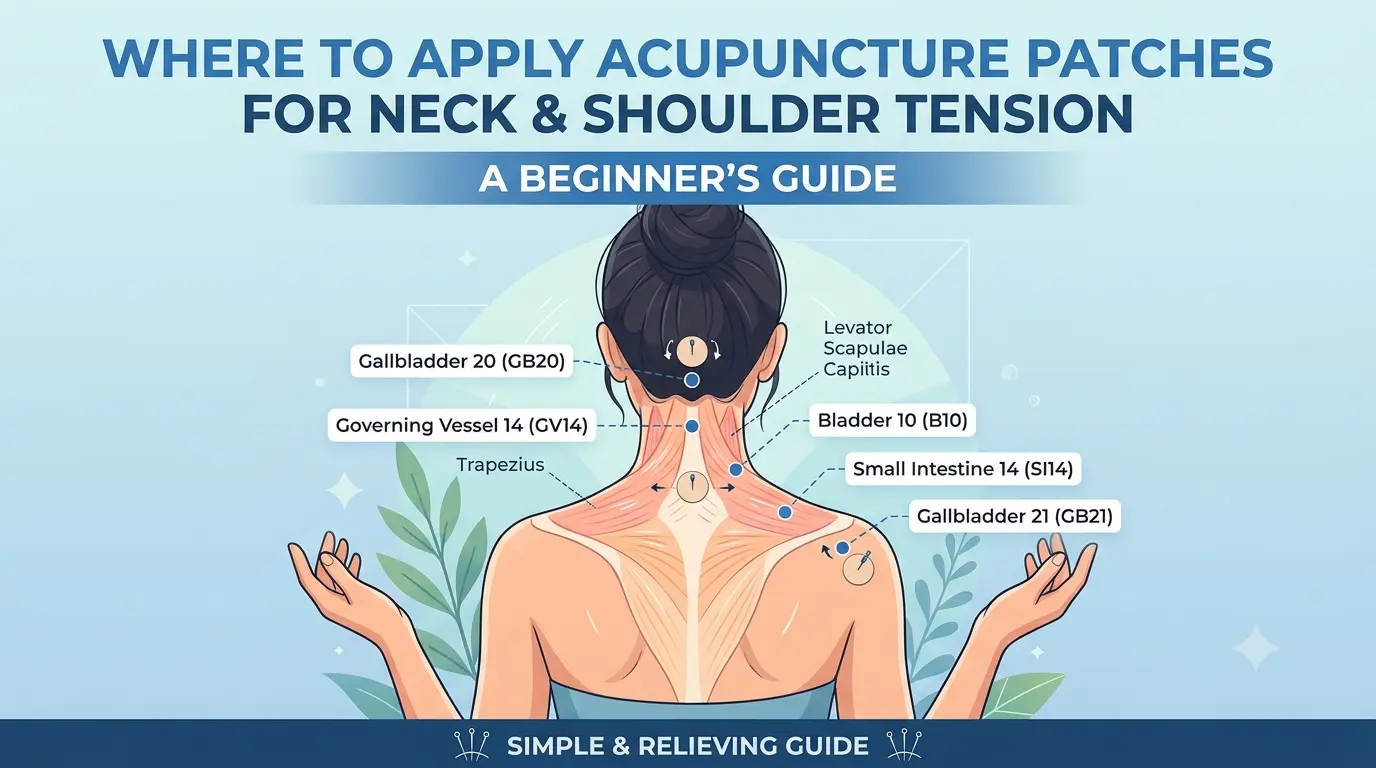
Traditional acupuncture and acupressure practices identify specific points around the neck and shoulder region. These are often discussed in guides about pressure points for neck pain.
One commonly referenced point is GB21, traditionally located in the upper trapezius muscle. Another is GB20, located near the base of the skull.
These point names are useful for understanding traditional practice, but they do not mean that every patch should be placed on them. A press-needle product’s instructions may not provide a point-by-point treatment plan, and the correct location can depend on the technique being used.
Should You Apply a Patch at GB21 or GB20?
Beginners should not attempt precise needle placement based only on a diagram or online description. The neck contains sensitive structures, and placement errors may cause discomfort or injury.
If you want to use an acupuncture-point approach, ask a qualified healthcare professional trained in acupuncture to explain which locations are appropriate for your circumstances.
Pregnancy precaution: GB21 has traditional pregnancy-related cautions. SPOLBAN’s current instructions also say not to use its product during pregnancy. Do not use the product if a manufacturer lists pregnancy as a contraindication.
4. Pressure Points for Shoulder Pain Relief
People researching pressure points for shoulder pain relief may come across points in the upper shoulder, near the shoulder blade and around the hand.
However, there is an important difference between using a fingertip for gentle acupressure and applying a patch with a needle component. The latter requires product-specific instructions and more care about placement.
If you are interested in pressure points to relieve neck and shoulder pain:
- Learn the location from a reliable source or qualified practitioner.
- Do not press directly on the front of the neck or over sensitive structures.
- Avoid strong pressure over the spine or injured tissue.
- Do not use pain as a reason to keep pressing harder.
- Stop if the technique causes sharp pain, tingling, dizziness or worsening symptoms.
Evidence for individual pressure points varies, and traditional use does not guarantee a clinical benefit. If symptoms persist or recur, assessment can help identify whether the discomfort is muscular or has another cause.
5. How to Apply a Japanese Press-Needle Patch Safely
If your product is a Japanese press-needle patch, follow its official instructions rather than a generic application method.
For SPOLBAN, the manufacturer’s published guidance includes the following steps.
Step 1: Read the Precautions
Before opening the package, check whether you should avoid the product because of pregnancy, allergies, an implanted medical device or another listed contraindication.
SPOLBAN specifically advises against use if you are pregnant, have a metal or acrylic adhesive allergy, or have an implanted medical electronic device such as a pacemaker.
Step 2: Clean and Dry the Skin
Wipe away dirt and sweat from the intended application area. The skin should be clean and dry so that the adhesive can attach properly.
Do not apply the patch over a wound, rash, infection or already irritated area.
Step 3: Follow the Product’s Application Directions
Open the packaging as directed and avoid touching the needle component. Position the patch only in an area permitted by the manufacturer.
Do not modify the patch, push the needle into the skin or attempt to create a treatment pattern of your own.
Step 4: Monitor the Application Site
Check the skin for increasing redness, itching, swelling, bleeding or other unexpected symptoms.
Remove the patch if it becomes painful or causes a reaction. Seek medical attention if you notice bleeding, signs of infection, significant swelling or an allergic reaction.
Step 5: Replace It as Directed
SPOLBAN’s official instructions recommend using each patch only once, replacing it every two to three days and shifting the location slightly with each new patch to help reduce skin irritation. Its guidance also says to remove the patch before entering public swimming pools.
These directions apply to SPOLBAN. Other products may have different instructions.
6. How to Choose the Best Neck Pain Relief Patches
There is no single product that can be described as the best neck pain relief patch for everyone. The most appropriate option depends on the cause of the pain, the product design and your medical circumstances.
Consider these factors before choosing a patch:
- Intended use: Is it designed for the neck, shoulder or another body area?
- Product type: Does it contain a needle component, medication, heat-producing ingredients or another mechanism?
- Safety information: Are the contraindications, application directions and wear time clearly explained?
- Materials: Does it contain metals or adhesives that may trigger a reaction?
- Evidence: Are the claims supported by reliable research rather than testimonials alone?
- Practicality: Can you apply it safely and monitor the area?
If neck discomfort includes numbness, weakness, persistent tingling or pain after an accident, choosing a patch should not be your first priority. Seek medical advice.
7. What About the Best Pain Relief Patch for Shoulder Discomfort?
The best pain relief patch for shoulder discomfort depends on what is causing the symptoms. A product used for temporary muscle tension may not be appropriate for a tendon injury, joint problem or nerve-related pain.
| Product type | Main approach | Key consideration |
|---|---|---|
| Japanese press-needle patch | Local physical stimulation | Follow needle-related precautions and manufacturer instructions |
| Medicated patch | Delivers a topical active ingredient | Check medicine-specific warnings and directions |
| Heat patch | Provides warmth | Avoid burns and follow the stated time limits |
| Cooling patch | Provides a cooling sensation | Cooling does not necessarily treat the underlying cause |
Avoid relying on advertising claims alone when comparing options. A product’s popularity does not prove that it will help your particular symptoms.
If your shoulder pain is severe, the shoulder is swollen or difficult to move, or the discomfort persists, consult a healthcare professional.
8. Can Acupuncture Patches Help with Lower Back Discomfort?
Although this guide focuses on neck and shoulder tension, people may also look for the best pain relief patch for lower back discomfort.
Lower back pain can have many causes, including muscle strain, joint problems and nerve irritation. A patch may be an optional symptom-management approach for some people, but it cannot diagnose the cause.
If you are considering a patch for your lower back:
- Confirm that the product is intended for that area.
- Apply it only to intact skin and according to its directions.
- Do not place a press-needle patch directly over the spine or an area excluded by the manufacturer.
- Do not use a patch to push through worsening pain.
- Seek advice if pain persists, recurs or interferes with daily activities.
Back pain with new bladder or bowel problems, numbness around the groin or saddle area, or significant new weakness requires urgent medical assessment.
9. What Does the Research Say About Press-Needle Patches?
Research into press-needle self-treatment is still limited, and results should be interpreted carefully.
A 2024 randomised controlled trial studied 50 participants with chronic neck pain who received press-needle or placebo treatment over three weeks. The researchers did not find a statistically significant difference in the primary pain-intensity measure. However, a measure of pain associated with movement improved more in the press-needle group than in the placebo group.
This study offers useful information, but it does not prove that every press-needle patch is effective or that the results apply to all types of neck and shoulder discomfort.
When considering Japanese pain relief patches , distinguish between:
- Traditional use of acupuncture points.
- Research on acupuncture or press-needle techniques generally.
- Evidence for a specific branded product.
- Individual customer experiences.
These are different forms of information. A cautious approach is to view press-needle patches as an optional self-care product rather than a guaranteed treatment.
10. Common Mistakes Beginners Should Avoid
Applying a Patch Anywhere That Hurts
The most painful spot is not automatically a suitable application area. Follow the product’s directions and avoid sensitive or prohibited locations.
Copying a Placement Diagram Without Understanding the Product
A diagram for one product or technique may not apply to another. If you are uncertain, ask a qualified professional.
Using Too Many Patches
Do not assume that applying several patches close together will improve results. Follow the manufacturer’s directions rather than creating your own treatment pattern.
Reusing a Single-Use Patch
Used press-needle patches should not be reused. Reuse can compromise hygiene and may increase the risk of problems.
Ignoring Skin Reactions
Remove the patch if you develop pain, redness, itching, swelling or other unexpected symptoms. Seek medical advice if the reaction is significant.
Using a Patch Instead of Getting Assessed
Persistent pain, pain after an accident or symptoms accompanied by weakness or numbness need appropriate assessment.
11. When Should You Seek Medical Advice?
Neck and shoulder tension is often associated with muscle strain or prolonged positioning, but not all pain is harmless.
Seek medical advice if the pain is persistent, repeatedly returns, affects sleep or daily activities, or does not improve with reasonable self-care.
Seek urgent medical assessment for severe pain after an injury, new weakness or numbness, significant swelling, or a neck that becomes very stiff with fever or severe headache.
Call emergency services if neck or shoulder pain occurs with chest pressure, shortness of breath, sweating or pain spreading to the jaw or arm.
Do not delay care while trying different patch placements.
Conclusion
Knowing where to apply acupuncture patches for neck and shoulder tension starts with understanding the product you have. Japanese press-needle patches, medicated patches and other adhesive products work differently, so their application instructions should not be mixed.
For beginners, the safest approach is to read the manufacturer’s directions, use only approved areas of intact skin, avoid sensitive locations and monitor for irritation. Traditional acupuncture points can help explain the background of these products, but they are not a substitute for personalised clinical advice.
If you are considering a Japanese press-needle patch such as SPOLBAN, review its official usage guidance and precautions before use. Combine suitable self-care with comfortable movement and seek professional advice if the discomfort persists, worsens or comes with other symptoms.
Where should I apply acupuncture patches for neck and shoulder tension?
The appropriate location depends on the product and its instructions. Some Japanese press-needle patches are intended for areas around the shoulder and upper back. Avoid the front of the neck, the spine, damaged skin and any area excluded by the manufacturer.
Can I put a press-needle patch directly on a pressure point?
Only if the product instructions permit the location and you can apply it safely. Beginners should not attempt precise needle placement based only on an online diagram. A qualified practitioner can provide guidance if point-specific treatment is being considered.
What are the common pressure points for neck pain?
Traditional practice commonly discusses points such as GB20 near the base of the skull and GB21 in the upper trapezius region. These point names do not mean that every patch should be applied there, and benefits are not guaranteed.
Are Japanese pain relief patches drug-free?
Some are, but not all Japanese pain relief patches have the same design. Japanese press-needle products such as SPOLBAN are marketed as drug-free, whereas other patches may contain active ingredients. Check the official product information.
What is the best neck pain relief patch?
There is no universally best patch. Compare the intended use, ingredients or needle design, safety precautions and supporting evidence. If your symptoms are persistent or accompanied by weakness or numbness, seek medical assessment.
