
Google Ads vs Facebook Ads: Which Is More Cost-Effective for Small Businesses?

Introduction
Small businesses often have limited marketing budgets, so every advertising dollar needs to work towards a clear business goal. Choosing the right advertising platform can make a significant difference to how effectively you attract customers, generate enquiries and increase sales.
Two popular options are Google Ads and Facebook Ads. Google Ads can help businesses reach people actively searching for products or services, while Facebook Ads can help businesses introduce their offerings to audiences based on interests, behaviours and other available targeting options. Facebook advertising is part of Meta’s advertising ecosystem, which also includes Instagram and other eligible placements.
So, Google Ads vs Facebook Ads: which is more cost-effective for small businesses?
The answer depends on your industry, audience, offer, campaign objective and ability to convert interested people into paying customers. A local plumber may benefit from appearing when someone searches for an emergency repair. In contrast, a clothing retailer might generate interest by showing attractive product images or videos to relevant audiences on Facebook and Instagram.
This guide compares both platforms, explains their costs, provides practical budget examples and shows you how to decide which option makes the most sense for your business.
Quick Answer: Google Ads vs Facebook Ads
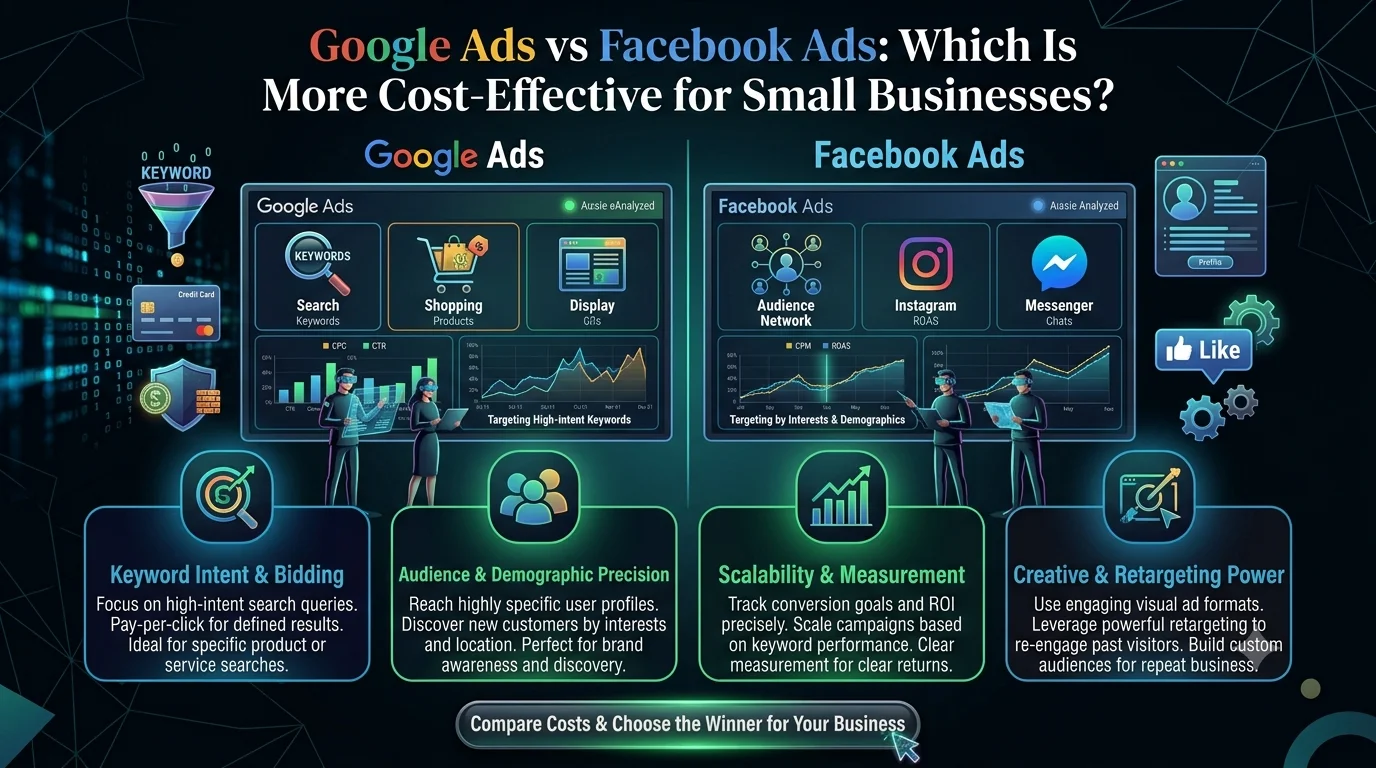
Neither platform is automatically more cost-effective for every small business. Google Ads is often a strong option when customers already search for what you offer. Facebook Ads can be useful when you need to create awareness, demonstrate a product or reach potential customers who may not be actively looking for it.
| Comparison factor | Google Ads | Facebook Ads |
|---|---|---|
| Main opportunity | Reach people searching for relevant products or services | Reach audiences through social media advertising |
| Customer intent | Often stronger for relevant, purchase-focused searches | Can reach people before they actively search |
| Common formats | Search, Shopping, Display, YouTube and Performance Max campaigns | Image, video, carousel, Reels and other eligible placements |
| Suitable businesses | Local services, professional services, ecommerce and high-intent offerings | Ecommerce, visual brands, events, lifestyle products and local businesses |
| Main cost measures | CPC, CPA, conversion rate and ROAS | CPC, CPM, CPA, conversion rate and ROAS |
| Potential challenge | Competitive searches can make customer acquisition expensive | Attention does not necessarily translate into immediate purchases |
| Best starting point | Businesses with clear search demand | Businesses that can reach and persuade audiences with effective creative |
The key is to measure what matters to your business. If your goal is to generate qualified leads, compare cost per qualified lead. If you sell products online, evaluate purchases, contribution margin and return on ad spend.
1. What Is the Difference Between Google Ads and Facebook Ads?
The biggest difference is how the platforms help businesses connect with potential customers.
How Google Ads works
Google Ads allows businesses to advertise across Google’s advertising network. Depending on the campaign type, ads can appear on Google Search, shopping results, YouTube, websites and other eligible placements.
For example, imagine you own a plumbing business in Perth. A potential customer searches for “emergency plumber Perth” because they need assistance. A relevant Search campaign may allow your business to appear when that person is looking for a plumber.
This makes Google Search particularly useful when there is existing demand for your product or service.
However, visibility is not guaranteed. Your ad’s eligibility and placement depend on factors such as the auction, targeting, budget, bidding, relevance and campaign settings.
How Facebook Ads works
Facebook Ads allows businesses to reach audiences through Facebook and, depending on their campaign settings, other Meta placements such as Instagram.
Rather than relying exclusively on people searching for a particular service, advertisers can use available audience options and creative content to reach people who may be interested in an offer.
For instance, a small skincare brand could show product demonstrations, customer-focused messaging or promotional offers to relevant audiences. A local café might use short videos to introduce its menu or promote a seasonal special.
This approach can help businesses generate awareness and interest before customers actively search for the brand.
Nevertheless, reaching a relevant audience does not guarantee that people will click, enquire or purchase. Creative quality, offer relevance, landing-page experience and campaign optimisation all influence results.
The practical difference
Google Search often helps capture existing demand, while Facebook Ads can help create demand and keep a business visible to potential customers.
These roles overlap. Google Ads can also introduce unfamiliar brands through visual campaigns, while Facebook Ads can convert people who are already familiar with a business.
The better choice depends on how customers discover, evaluate and purchase what you sell.
2. How Much Do Google Ads and Facebook Ads Cost?
Neither platform has one universal advertising price. Your actual costs depend on competition, audience, campaign objective, location, bidding strategy, creative quality and other factors.
It is also important to distinguish advertising spend from the total cost of running a campaign. Agency fees, creative production, landing-page development and tracking setup may be additional expenses.
Google Ads costs
Google Ads provides campaign budgeting and bidding options that allow businesses to manage their advertising investment.
For campaigns using cost-per-click bidding, you pay for clicks according to the applicable billing model and campaign settings. Your actual average CPC may be lower or otherwise differ from the maximum CPC bid you set.
Google’s official guidance explains that advertisers choose an average daily budget, and monthly spending limits for most campaigns are generally calculated using 30.4 times the average daily budget. Daily spending can fluctuate within the platform’s applicable limits.
Read the official Google Ads budget guidance before setting your campaign budget.
Your Google Ads costs can vary based on:
- The competitiveness of your target searches
- The relevance of keywords, ads and landing pages
- The location and audience you target
- Your campaign type and bidding strategy
- The conversion rate of your website
- The value of each lead or sale to your business
A campaign targeting competitive commercial searches may cost more per click than one targeting a narrower set of searches. However, a more expensive click can still be worthwhile if it produces valuable customers.
Facebook Ads costs
Facebook Ads costs vary according to the audience, placements, campaign objective, auction conditions, creative and optimisation strategy.
Common metrics include:
- Cost per thousand impressions (CPM): The cost of showing ads 1,000 times.
- Cost per click (CPC): The average cost for the clicks included in your chosen reporting metric.
- Cost per lead (CPL): The advertising spend divided by the number of leads generated.
- Cost per acquisition (CPA): The advertising spend divided by the number of defined acquisitions, such as purchases.
- Return on ad spend (ROAS): Attributed advertising revenue divided by advertising spend.
A campaign optimised for reach may deliver a different result from one optimised for leads or purchases. Therefore, comparing the CPC of two campaigns with different goals may not tell you which is more profitable.
Example: A $1,000 monthly advertising budget
Suppose a small business can allocate $1,000 per month to advertising. It wants to compare two hypothetical campaigns.
| Metric | Google Ads example | Facebook Ads example |
|---|---|---|
| Monthly advertising spend | $1,000 | $1,000 |
| Assumed average CPC | $2.00 | $1.00 |
| Estimated clicks | 500 | 1,000 |
| Assumed conversion rate | 5% | 2% |
| Estimated conversions | 25 | 20 |
| Advertising cost per conversion | $40 | $50 |
These figures are illustrative, not verified platform averages or forecasts. They assume every dollar of the stated spend generates clicks at the assumed CPC and that the conversion rates remain consistent.
In this scenario, Facebook Ads generates more clicks, but Google Ads generates more conversions at a lower cost per conversion.
The result could be reversed in another business. Facebook Ads might outperform Google Ads if its creative attracts highly relevant buyers, while a Google Search campaign might struggle if search demand is limited or competition is expensive.
The lesson is to compare the cost and value of actual business outcomes, not just the price of traffic.
3. Which Platform Offers a Better Return on Investment?
The most cost-effective platform is the one that helps your business achieve its objectives at a sustainable cost.
To make a fair comparison, measure both platforms using the same business outcome and a consistent reporting period.
Compare cost per lead
For service businesses, cost per lead can be a useful starting point. However, not every enquiry is equally valuable.
Suppose Google Ads generates 20 enquiries at an advertising cost of $1,000. The cost per lead is $50.
Meanwhile, Facebook Ads generates 40 enquiries at the same cost, giving it a $25 cost per lead.
At first glance, Facebook appears more efficient. Yet imagine that only 5 of its enquiries become customers, compared with 8 customers from Google Ads.
The acquisition costs would be:
| Metric | Google Ads | Facebook Ads |
|---|---|---|
| Advertising spend | $1,000 | $1,000 |
| Leads generated | 20 | 40 |
| Customers acquired | 8 | 5 |
| Cost per lead | $50 | $25 |
| Cost per customer | $125 | $200 |
Google Ads delivers fewer leads but acquires customers at a lower advertising cost in this hypothetical example.
This is why lead quality, sales conversion rate and revenue should be part of your evaluation.
Compare return on ad spend
For ecommerce businesses, ROAS can help compare the revenue attributed to each advertising platform.
Formula:
ROAS = Attributed advertising revenue ÷ Advertising spend
For example, if a campaign spends $1,000 and generates $4,000 in attributed revenue, its ROAS is 4.0x.
That means the campaign generates $4 in attributed revenue for each $1 spent on ads. It does not mean the business earns $3 in profit.
Product costs, fulfilment, shipping, returns, payment fees and other expenses must also be considered.
Consider profit, not just revenue
A business selling products with high margins may be able to afford a higher acquisition cost than a business operating on narrow margins.
Likewise, a lead-generation company may be able to pay more for a qualified lead if its sales team converts a strong proportion of those leads into profitable customers.
When comparing Google Ads and Facebook Ads, calculate the maximum cost your business can afford for a sale or qualified lead. Then use that target to evaluate campaign performance.
4. Google Ads vs Facebook Ads for Different Small Businesses
The best advertising platform often depends on the product or service you sell and how customers typically discover it.
Local service businesses
Businesses such as plumbers, electricians, pest controllers and emergency repair providers may benefit from Google Search because customers often search when they need a service.
For example, a person searching for “electrician near me” may be actively looking to hire someone. A well-targeted Google Ads campaign can help a business reach that demand.
Facebook Ads can also support local services by promoting seasonal offers, showcasing completed projects, building awareness and reaching relevant local audiences.
Practical approach: Consider Google Search first when customers regularly search for the service they need. Use Facebook Ads when awareness, visual proof or local promotion is an important part of the sales process.
Ecommerce businesses
Online stores can use both platforms for different purposes.
Google Shopping and Search campaigns can reach shoppers searching for products or comparing options. Facebook and Instagram ads can showcase product benefits, demonstrate how items are used and introduce products to potential customers.
For a fashion brand, attractive images and videos may be central to generating interest. A specialist retailer selling replacement parts may depend more heavily on customers searching for exact product names or specifications.
Practical approach: Match the channel to how customers discover the product. Compare purchase CPA and profit contribution, not simply the number of clicks.
Professional services
Accountants, consultants, legal firms and other professional service providers may use Google Ads to reach people actively looking for a particular service.
Facebook Ads can help communicate expertise, distribute educational content and keep the business visible to relevant audiences.
Because professional services may involve longer decision-making periods, a campaign’s value may not be fully visible immediately after the first click.
Practical approach: Track qualified enquiries, booked consultations and actual new clients wherever possible.
Restaurants, cafés and retail shops
Local businesses can use Google Ads to reach people searching for nearby options, particular products or specific services.
Facebook Ads can promote new menus, seasonal offers, events, product launches and community-focused content.
For example, a café might use Facebook and Instagram to showcase its food, while Google Search could help reach someone looking for a café nearby.
Practical approach: Choose based on whether the immediate goal is to capture existing local searches or encourage people to discover and visit your business.
New businesses and unfamiliar products
A business with little brand recognition may need to introduce its products before customers begin searching for them by name.
Facebook Ads can help present the offer to relevant audiences through creative content. Google Ads can still be useful if customers search for the broader product category or problem the business solves.
Practical approach: Test which channel can reach relevant potential customers and generate meaningful actions within your budget.
5. How to Calculate Advertising Cost-Effectiveness
Before choosing a platform, establish a simple measurement framework. You do not need a complicated spreadsheet to start, but you do need reliable figures.
Step 1: Set a clear objective
Decide what you want your advertising to achieve.
Possible objectives include:
- Generate qualified leads
- Increase online purchases
- Book appointments
- Receive phone calls
- Increase store visits
- Promote a new product
- Build awareness for an unfamiliar brand
The right metric depends on the objective. For example, impressions can help assess reach, while qualified leads or purchases are more useful for evaluating direct-response campaigns.
Step 2: Calculate cost per click
Average CPC = Advertising spend ÷ Clicks
If you spend $600 and receive 300 clicks, your average CPC is $2.
This helps you understand the cost of attracting traffic, but it does not reveal whether that traffic is commercially valuable.
To explore Google Ads click costs before launching a campaign, use the Scalvia Google Ads CPC Calculator . It can help you work through cost-per-click calculations and plan different budget scenarios.
Step 3: Calculate conversion rate
Conversion rate = Conversions ÷ Clicks × 100
If 15 people convert from 300 clicks, the conversion rate is 5%.
Ensure that the conversion event reflects a meaningful action. A completed purchase, qualified lead or booked appointment is generally more useful for business evaluation than an unqualified page visit.
Step 4: Calculate cost per acquisition
CPA = Advertising spend ÷ Acquisitions
If you spend $600 and acquire 12 customers, your advertising CPA is $50.
For a lead-generation campaign, you may also want to calculate cost per qualified lead and cost per customer separately. This helps reveal whether one platform generates many low-quality enquiries or fewer valuable prospects.
Step 5: Measure business value
Finally, compare the cost of acquiring customers with the revenue and contribution they generate.
For an ecommerce business, look at revenue and margins. For a service business, assess the value of completed jobs and the proportion of leads that become paying customers.
Use consistent attribution settings and reporting periods when comparing platforms. Different tracking systems may attribute the same conversion differently, so reported totals do not always match perfectly.
6. Advantages and Disadvantages of Google Ads
Google Ads can be highly useful for small businesses, particularly when there is clear demand for their products or services.
Advantages of Google Ads
Reaches active searchers. Search campaigns can help your business appear when people look for a service, product or solution.
Supports measurable goals. With suitable conversion tracking, you can assess clicks, enquiries, purchases and acquisition costs.
Offers multiple campaign formats. Depending on your objective, you can use Search, Shopping, Display, YouTube and other campaign types.
Provides budget controls. You can set campaign budgets and adjust them as your business needs change.
Can support local targeting. Location settings can help you focus advertising on relevant service areas, although correct configuration is important.
Disadvantages of Google Ads
Competition can be expensive. Popular commercial searches may attract many advertisers, affecting the costs and traffic available to your campaign.
Search demand may be limited. If few people search for a new or unfamiliar product, Search campaigns alone may not generate enough reach.
Poor targeting can waste spend. Broad or irrelevant searches may attract clicks from people unlikely to purchase.
The website must convert visitors. Strong ad visibility cannot compensate for confusing landing pages, uncompetitive offers or a difficult checkout.
Results require ongoing management. Keyword reviews, conversion tracking, search-term analysis and budget adjustments can all require time and expertise.
7. Advantages and Disadvantages of Facebook Ads
Facebook Ads can be valuable when a business needs to attract attention, introduce products or engage relevant audiences.
Advantages of Facebook Ads
Strong visual storytelling opportunities. Images, videos and carousel formats can help explain products, demonstrate benefits and communicate brand personality.
Audience-based reach. Available targeting options can help advertisers reach audiences based on eligible characteristics and platform signals.
Useful for product discovery. Facebook and Instagram ads can introduce products to people who were not actively searching for them.
Supports awareness and direct response. Campaigns can be designed around objectives such as reach, engagement, leads or sales, depending on eligibility and setup.
Can complement other marketing channels. Social advertising may help businesses stay visible to audiences who have previously interacted with their brand, subject to consent, platform rules and available audience data.
Disadvantages of Facebook Ads
Interest does not equal purchase intent. Someone viewing a product in their feed may not be ready to buy.
Creative fatigue can occur. An ad that initially attracts attention may become less effective as audiences see it repeatedly.
Lead volume can hide poor quality. A campaign may generate many form submissions without producing enough paying customers.
Performance depends on the offer and creative. Weak visuals, unclear messaging or an unconvincing offer can undermine results.
Attribution can be difficult. People may see an ad, visit later through another channel and purchase without the original interaction receiving full credit in your reporting.
For the best results, define your campaign objective carefully and evaluate the business outcomes that matter to your organisation.
8. Should Small Businesses Use Both Platforms?
Using both Google Ads and Facebook Ads can make sense when your budget, tracking and marketing resources support a coordinated strategy.
The platforms can serve different stages of the customer journey. Google Search can capture people looking for a solution, while Facebook Ads can introduce a brand, demonstrate benefits or help re-engage eligible audiences.
Consider a small Australian home renovation company.
Google Search campaigns could target relevant searches from people looking for renovation services in its service area. Facebook and Instagram campaigns could showcase completed projects, explain the renovation process and promote consultation opportunities.
The combined strategy gives potential customers different ways to discover and evaluate the business.
However, running both platforms is not automatically better. Splitting a small budget across too many campaigns may limit the data available for optimisation.
How to split a limited budget
There is no universal percentage that every small business should allocate to each platform. Instead, use your current evidence and business goals to guide the split.
A practical process is:
- Identify the platform most closely aligned with your immediate business objective.
- Allocate enough budget to test that channel meaningfully.
- Track qualified leads, purchases or another primary conversion.
- Review acquisition costs and the quality of results.
- Test the second platform when you can measure its contribution.
- Adjust spending based on performance rather than habit.
For a business with strong search demand, Google Ads may deserve a larger initial share. For a visually distinctive product that customers discover through social media, Facebook Ads may deserve more attention.
As results accumulate, your budget allocation can change.
9. How to Choose the Right Platform for Your Budget
Use the following questions to decide where to begin.
Do customers actively search for what you sell?
If people regularly search for your product or service, Google Search is worth investigating. Use keyword research to understand search demand and potential CPCs before committing to a budget.
Google’s official bidding and budgeting guidance explains how to set budgets and choose bidding options.
Is your product easy to demonstrate visually?
If images or videos can quickly show the value of your product, Facebook and Instagram ads may be useful channels for discovery and promotion.
Think about whether your creative can communicate the product’s benefit within a few seconds and give the audience a clear next step.
What does a customer need before purchasing?
A person who urgently needs a plumber may be ready to contact a provider immediately. Someone considering an expensive furniture purchase may browse several options, compare reviews and take time to decide.
Understanding the customer journey helps you choose a channel and measurement period that suit the buying process.
Can your business afford the expected acquisition cost?
Estimate your acceptable CPA before launching. If the likely cost of acquiring a customer exceeds the contribution that customer generates, the campaign may not be sustainable without changes to pricing, conversion rate or other business factors.
Can you track results reliably?
Accurate tracking is essential for comparing advertising platforms. Configure appropriate conversion events, test that they work and distinguish between meaningful actions and low-value interactions.
Without reliable data, it becomes much harder to decide which campaign deserves more budget.
10. Common Advertising Mistakes to Avoid
Choosing a platform based only on CPC
A low CPC may look attractive, but it can be misleading if visitors do not convert. Compare CPA, qualified leads, sales and profitability.
Using the same creative everywhere
A search ad and a social media ad serve different contexts. Search ads should closely match the user’s query, while social ads often need to capture attention and communicate value quickly.
Adapt the message to the placement and the audience’s likely intent.
Ignoring the landing page
Sending paid traffic to an irrelevant or confusing page can waste budget. Ensure the landing page matches the ad promise and makes the next step obvious.
Measuring every lead as equal
A form submission is not always a qualified prospect. Track lead quality and sales outcomes where possible, particularly for services with longer sales cycles.
Changing campaigns too frequently
Frequent changes can make results difficult to interpret. Allow enough time and data to evaluate performance, while still acting promptly if tracking is broken or spend is clearly misconfigured.
Forgetting the full cost of advertising
Your true marketing investment may include media spend, agency fees, creative production, landing-page development and analytics tools. Include these costs when evaluating the overall return.
11. Final Thoughts
Choosing between Google Ads and Facebook Ads is not simply a matter of finding the platform with the lowest CPC. It is about understanding how customers discover your business, what persuades them to take action and how much you can afford to spend to acquire them.
Google Ads can be especially useful when people are actively searching for the products or services you provide. Facebook Ads can help businesses build awareness, showcase products and reach relevant audiences before they begin searching. Depending on your business model, either platform—or a carefully measured combination of both—may deliver the best result.
Before launching a campaign, establish a clear objective, calculate your acceptable acquisition cost and make sure conversion tracking is reliable. Review the quality and value of the customers you acquire, not just the clicks or leads you receive.
If Google Ads is part of your plan, the Scalvia Google Ads CPC Calculator can help you explore cost-per-click calculations and budget scenarios before committing your advertising spend.
The most cost-effective advertising platform is the one that consistently helps your business acquire the right customers at a sustainable cost.
Is Google Ads cheaper than Facebook Ads?
Neither platform is always cheaper. Facebook Ads may generate inexpensive clicks or broad reach in some campaigns, while Google Ads may produce stronger results from people actively searching for a service. Compare the cost per qualified lead, customer or sale to understand which platform is more cost-effective for your business.
Which is better for small businesses: Google Ads or Facebook Ads?
Google Ads can be a strong starting point when customers actively search for your service or product. Facebook Ads may be more suitable when visual content, product discovery and audience reach are important. Your industry, customer journey and budget should determine the choice.
Is Facebook Ads good for lead generation?
Yes, Facebook Ads can support lead-generation campaigns. However, the number of leads is only one measure of success. Track lead quality, follow-up rates, appointments and paying customers to determine whether the campaign is generating valuable opportunities.
Is Google Ads worth it for a small business?
Google Ads can be worthwhile when there is relevant search demand, your targeting is appropriate and the cost of acquiring customers fits your business economics. Results are not guaranteed, so start with a defined objective, reliable tracking and a budget you can afford to test.
Can I start Google Ads and Facebook Ads with a small budget?
You can test either platform with a limited budget, but the amount of data available may be small. Begin with a clear objective and avoid spreading your budget across too many campaigns before you have evidence of what works.
