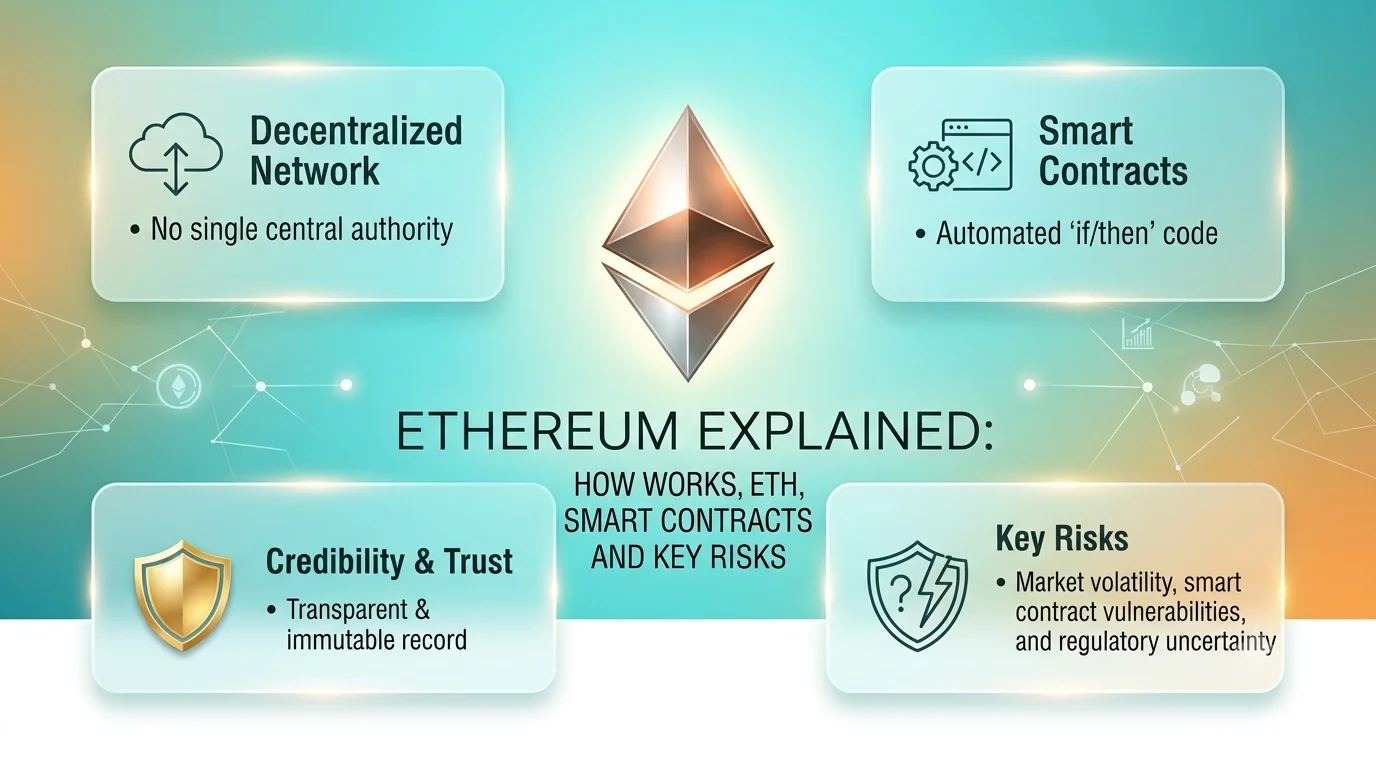
Ethereum Explained: How It Works, ETH, Smart Contracts and Key Risks.

Introduction
Ethereum is one of the best-known blockchain platforms, but its purpose goes beyond transferring digital currency. It provides a shared computing network where developers can build applications, create digital assets and execute programmes without relying entirely on a central operator.
Its native cryptocurrency, Ether (ETH), plays an important role in this system. Users can pay transaction fees with ETH, developers can use the network to run smart contracts, and eligible participants can stake ETH to help secure the blockchain.
These features have made Ethereum an important part of the broader cryptocurrency ecosystem. However, understanding how it works requires more than knowing its token price or following market headlines. Network fees, smart contract risks, wallet security and market volatility can all affect how people use it.
This guide explains Ethereum in straightforward language, including its technology, common applications, staking process, advantages, limitations and security considerations. It also explores the difference between Ethereum and Ether, two terms that are frequently used interchangeably.
Whether you are researching blockchain technology for the first time or looking to understand ETH more clearly, this article provides a practical starting point.
Quick Answer: What Is Ethereum?
Ethereum is a decentralised blockchain network that supports digital transactions and programmable applications. Its native cryptocurrency is Ether, commonly identified by the ticker symbol ETH.
Unlike a blockchain designed primarily for payments, Ethereum supports smart contracts: programmes that execute according to rules stored on the network. These programmes enable decentralised finance applications, digital asset marketplaces, games and other blockchain-based services.
| Question | Quick Answer |
|---|---|
| What is Ethereum? | A programmable, decentralised blockchain network |
| What is ETH? | Ethereum’s native cryptocurrency |
| What is Ethereum used for? | Transactions, smart contracts, decentralised applications and staking |
| What are gas fees? | Fees paid for computation and transactions on the network |
| Does Ethereum use mining? | No. Mainnet uses proof-of-stake consensus |
| What is staking? | Committing ETH to participate in network validation, directly or through a service |
| Is Ethereum an investment? | ETH can be bought and held as a crypto asset, but its value can fluctuate significantly |
| Is Ethereum risk-free? | No. Technical, financial, security and regulatory risks remain |
1. What Is Ethereum?
Ethereum is a public blockchain that allows people and applications to interact with a shared digital system. Instead of depending on a single organisation to maintain the entire transaction record, the network uses participating computers, cryptographic techniques and a consensus mechanism to maintain a common state.
The project was proposed by Vitalik Buterin in 2013, and the Ethereum network launched in 2015.
One of its defining features is programmability. Developers can deploy software directly onto the blockchain in the form of smart contracts. Users can then interact with those programmes through compatible wallets and applications.
For example, a developer might create a marketplace where users exchange digital collectibles. A smart contract can define how listings, payments and transfers work, subject to the contract’s code and the application’s design.
Ethereum therefore acts as both a transaction network and a platform for building applications.
What Makes Ethereum Different?
Traditional online applications usually depend on servers controlled by a company or service provider. Ethereum applications can instead rely on smart contracts deployed to a blockchain shared across many independent participants.
This arrangement can offer transparency and reduce dependence on a single operator. However, it does not mean that every application built on Ethereum is fully decentralised. Some still depend on centralised websites, administrators, external data providers or other services.
According to the official Ethereum documentation, the network functions as a shared computing environment in which participants agree on the state of the blockchain.
2. How Does Ethereum Work?
Ethereum combines several technical components to process transactions and execute applications.
Blockchain Records
A blockchain stores information in linked blocks. Transactions are collected, processed and recorded as the network advances.
Participating nodes independently verify relevant information according to the network’s rules. This shared verification helps maintain consistency across the system.
Although blockchain records are designed to be difficult to alter, users should not interpret this as a guarantee that every transaction is reversible or that every application is secure.
Nodes and Validators
Nodes run Ethereum client software and help maintain or verify the network’s state.
Validators participate in Ethereum’s proof-of-stake consensus mechanism. They help propose and attest to blocks, allowing the network to agree on which transactions and state changes are valid.
Ethereum switched from proof-of-work to proof-of-stake in September 2022. As a result, mining through the old proof-of-work mechanism is no longer how Ethereum Mainnet reaches consensus.
Proof of Stake
Under proof of stake, participants commit ETH as economic collateral when operating validators. The protocol rewards appropriate participation and can penalise certain forms of misconduct or prolonged operational problems.
A person running a solo validator needs to deposit 32 ETH and operate the necessary software. Other staking arrangements allow participation with different requirements, although they introduce additional dependencies and risks.
Smart Contract Execution
Ethereum also maintains an execution environment known as the Ethereum Virtual Machine (EVM).
Smart contracts contain instructions that the network executes when users submit suitable transactions. For instance, a contract might transfer a digital token when specified conditions are satisfied.
Because execution consumes network resources, users pay fees for transactions and contract interactions. This fee mechanism helps allocate limited computing capacity and discourages wasteful activity.
3. Ethereum vs Ether: What Is the Difference?
Ethereum and Ether are closely related, but they are not the same thing.
Ethereum refers to the blockchain network and its programmable computing environment.
Ether (ETH) is the cryptocurrency used within that ecosystem.
The distinction matters because discussions about Ethereum often mix technology with investment performance.
| Term | Meaning |
|---|---|
| Ethereum | The blockchain network and application platform |
| Ether | The native cryptocurrency of Ethereum |
| ETH | The ticker symbol for Ether |
| Blockchain | The distributed record of transactions and state |
| Smart contract | A programme deployed to and executed by the network |
| Gas | A measure of computational work used to calculate transaction fees |
| Validator | A participant that helps secure Ethereum’s proof-of-stake consensus |
For example, someone might say that Ethereum is becoming more useful because developers are building new applications. That statement concerns the platform.
By contrast, saying that ETH has increased in price describes the market value of its cryptocurrency.
The two may influence each other, but they are not interchangeable measures. A technically useful network does not guarantee that its token price will rise.
4. What Is ETH Used For?
Ether supports several important functions across the Ethereum ecosystem.
Paying Transaction Fees
Users generally need ETH to pay gas fees for transactions and smart contract execution on Ethereum Mainnet.
The fee depends on factors such as the computational resources required and network demand. Consequently, the cost of an action can change over time.
Transferring Value
ETH can be sent between compatible blockchain addresses without requiring a traditional bank to record the transfer.
However, users must select the correct network, check the recipient address and understand the transaction before signing. Transfers made to an incorrect address may be difficult or impossible to recover.
Supporting Decentralised Finance
Decentralised finance, commonly called DeFi, uses blockchain applications to offer activities such as lending, borrowing, exchanging tokens and providing liquidity.
ETH may serve as an asset, a trading pair or collateral within these applications. Nevertheless, using a DeFi service involves risks beyond ordinary price fluctuations, including smart contract vulnerabilities, liquidation and liquidity problems.
Participating in Staking
ETH can be staked to help secure the network.
Depending on the method used, participants may operate their own validator, delegate operational responsibilities or use a pooled staking service. The requirements, fees and risks differ.
Buying Digital Assets
ETH is used in many transactions involving digital collectibles, tokenised assets and other blockchain-based products.
Some marketplaces use ETH as a payment currency, although others support different tokens or payment arrangements. Availability depends on the application.
Supporting Ethereum Applications
Developers and users interact with applications deployed on Ethereum by submitting transactions that execute smart contract code.
These applications may support gaming, digital identity experiments, community projects and many other use cases. Their practical value depends on implementation, adoption and the problems they actually solve.
5. What Are Ethereum Smart Contracts?
Smart contracts are programmes stored and executed on a blockchain. They define how particular actions occur when users interact with them.
The term contract can be misleading because a smart contract is not automatically a legally enforceable agreement. It is primarily software whose behaviour follows its code and the rules of the network.
How Smart Contracts Work
Consider a simple digital marketplace.
- A seller lists a digital item through an application.
- A buyer submits a transaction to purchase it.
- The relevant smart contract checks the conditions encoded in its programme.
- If those conditions are satisfied, the contract executes the defined transfer.
- The resulting state change is recorded on the blockchain.
The precise process depends on the application. A poorly designed contract can still contain errors, and some systems depend on administrators or external services.
Common Smart Contract Applications
Decentralised exchanges: These allow users to exchange digital tokens through blockchain-based mechanisms.
Lending protocols: Some applications let users supply assets, borrow against collateral or interact with automated interest mechanisms.
NFT marketplaces: Smart contracts can record ownership and transfers of non-fungible tokens.
Blockchain games: Developers can use contracts to manage certain in-game assets, rewards or transactions.
Decentralised organisations: Some communities use smart contracts to manage proposals, voting mechanisms and treasury rules.
These applications demonstrate Ethereum’s flexibility. At the same time, decentralisation does not eliminate operational, governance or financial risks.
6. What Are Ethereum Gas Fees?
Gas fees are charges for the computational resources needed to process transactions and execute smart contracts.
Every transaction consumes a certain amount of gas according to the operations it performs. The amount of ETH paid also depends on the applicable gas price.
What Determines Gas Costs?
Several factors affect the final fee:
- Network demand: Fees can increase when many users compete for limited block space.
- Transaction complexity: More computationally demanding operations generally require more gas.
- Smart contract activity: Interacting with complex applications can cost more than sending a basic transfer.
- Fee market conditions: The network’s fee mechanism changes with demand.
Ethereum’s use of proof of stake does not automatically make transactions cheaper. Gas fees remain influenced by demand for network resources.
How to Manage Gas Fees
Before confirming a transaction, review the estimated fee displayed by your wallet.
You can also:
- Avoid submitting transactions when fees are unusually high, if the action is not urgent.
- Compare the cost of using Ethereum Mainnet with the cost and risks of compatible layer-2 networks.
- Check the official network details before moving assets between networks.
- Avoid repeatedly submitting transactions without understanding their status.
- Confirm that the transaction is interacting with the intended application.
A lower fee should not be the only consideration. A network or application must also be appropriate for your assets and intended transaction.
7. How Does Ethereum Staking Work?
Staking is a way to participate in Ethereum’s proof-of-stake security mechanism by committing ETH.
Validators check proposed blocks, attest to the chain’s state and perform other protocol duties. In return, eligible participants can receive rewards for appropriate participation.
However, staking is not a guaranteed-income product. Returns and risks depend on the staking method, validator performance, fees and market conditions.
Solo Staking
Solo staking involves running your own validator infrastructure.
Ethereum requires a 32 ETH deposit to activate an individual validator. The operator must also maintain suitable hardware, software and network connectivity.
This approach offers direct participation but requires technical knowledge and ongoing maintenance.
Pooled Staking
Pooled staking allows multiple participants to combine resources through a service or protocol.
It may provide access to staking without requiring each user to operate a validator with 32 ETH. However, the arrangement introduces additional risks, such as smart contract vulnerabilities, operator failures, fees and liquidity limitations.
Exchange-Based Staking
Some cryptocurrency exchanges offer staking services to customers.
These services may be convenient, but users must evaluate the provider’s terms, custody arrangements, withdrawal conditions and operational risks. Holding ETH with a third party also exposes users to risks associated with that organisation.
What Are the Risks of Staking?
Important considerations include:
- Validator penalties and possible slashing
- Missed rewards when a validator fails to perform properly
- Smart contract vulnerabilities in pooled arrangements
- Provider or custodian failure
- Withdrawal delays or liquidity restrictions
- Changes in the market price of ETH
The official Ethereum staking guide explains the available approaches and their trade-offs. Review the current terms of any staking service before committing assets.
8. What Are the Benefits of Ethereum?
Ethereum has several characteristics that make it useful to developers, businesses and individual users.
Programmability
Smart contracts allow developers to build applications with rules that execute on the network. This supports use cases that go beyond simple transfers.
An Open Development Environment
Ethereum’s public infrastructure allows developers to build compatible applications without needing permission from a single central platform owner.
Nevertheless, individual applications can still impose access restrictions or depend on centralised infrastructure.
A Broad Application Ecosystem
Ethereum supports a range of financial applications, digital assets, games and experimental services. This variety gives developers different ways to use blockchain technology.
Shared and Verifiable Records
Blockchain transactions can be inspected through compatible explorers. This transparency can help users verify activity and review contract interactions, although interpreting complex transactions may require technical knowledge.
Proof-of-Stake Consensus
Ethereum’s transition to proof of stake substantially reduced the network’s energy consumption compared with its former proof-of-work system.
That change was an important technical milestone. It does not mean the network has no environmental impact, since hardware, internet infrastructure and related services still consume resources.
Support for Further Scaling
Ethereum’s ecosystem includes layer-2 networks designed to process transactions with different cost and performance characteristics while using Ethereum for some aspects of security or settlement.
Layer-2 systems can improve usability, but they are not identical. Their security assumptions, withdrawal procedures and technical designs should be assessed individually.
9. What Are the Risks and Limitations?
Ethereum’s capabilities do not remove the risks associated with blockchain technology or cryptocurrency ownership.
Price Volatility
ETH can experience substantial price movements over short periods.
Its market value is influenced by investor sentiment, liquidity, broader economic conditions, regulation, competition and developments within the crypto industry. There is no reliable way to guarantee future prices.
Smart Contract Vulnerabilities
Smart contracts can contain coding errors or design weaknesses. An exploit may lead to the loss of assets, and recovering funds can be difficult.
Before interacting with a protocol, review its documentation, audit information and security history where available. An audit can reduce uncertainty but cannot guarantee that a system is safe.
Wallet and Phishing Risks
Scammers may create imitation websites, fake support accounts or fraudulent investment offers to obtain wallet credentials.
A compromised private key or recovery phrase can allow another person to control the associated assets. Ethereum transactions are generally irreversible once confirmed, so prevention is essential.
Transaction Errors
Sending ETH to the wrong address or selecting an incompatible network can result in lost funds.
Always verify the complete destination address and network before confirming a transfer. For a new recipient, consider a small test transaction when appropriate and affordable.
Gas Fees and Congestion
Network fees can become expensive when demand rises. This may make smaller transactions less practical and affect the cost of using decentralised applications.
Alternative networks can offer different cost structures, but they introduce their own technical and security considerations.
Regulatory Uncertainty
Rules governing cryptocurrency trading, custody, taxation and related services vary by jurisdiction and may change.
Users should consult the relevant local authorities or qualified professionals for guidance about their own circumstances. A platform operating in one country may not be available or legally permitted in another.
Staking and Third-Party Risks
Staking through a provider introduces risks that differ from holding ETH in a self-controlled wallet. A provider may impose fees, restrict withdrawals or experience operational or financial problems.
Similarly, decentralised staking protocols can involve smart contract and liquidity risks.
For a broader discussion of crypto-asset investment risks, consult Investor.gov’s crypto-asset investor guidance.
10. Ethereum vs Bitcoin
Ethereum and Bitcoin are major blockchain networks, but they were designed with different priorities.
Bitcoin primarily focuses on peer-to-peer digital value transfer and a monetary asset with a predetermined issuance schedule. Ethereum supports digital transfers as well as programmable applications through smart contracts.
| Feature | Ethereum | Bitcoin |
|---|---|---|
| Native asset | Ether (ETH) | Bitcoin (BTC) |
| Consensus mechanism | Proof of stake | Proof of work |
| Main design emphasis | Programmable blockchain and applications | Peer-to-peer digital money and monetary settlement |
| Smart contracts | Supports general-purpose smart contract execution | Supports transaction scripting with a more limited design |
| Network participation | Validators stake ETH | Miners use computing power |
| Transaction fees | Paid in ETH for Ethereum Mainnet execution | Paid in BTC for Bitcoin transactions |
| Token supply design | Issuance and burning vary with protocol activity | Maximum supply of 21 million BTC under current consensus rules |
Neither network is automatically superior for every purpose. The appropriate choice depends on whether a user values a particular application’s capabilities, monetary design, transaction requirements or security assumptions.
It is also important to avoid assuming that the historical price performance of one asset predicts the future performance of the other.
11. How to Get Started With Ethereum
If you want to explore Ethereum, begin by learning how wallets, transactions and network selection work before committing significant funds.
Step 1: Learn the Basics
Understand the distinction between Ethereum and ETH, how gas fees work and why private keys matter.
The official Ethereum website provides introductory material, developer documentation and security guidance.
Step 2: Choose a Suitable Wallet
An Ethereum-compatible wallet allows you to manage addresses and interact with compatible applications.
Wallets differ in custody, supported networks, recovery methods and security features. Research the provider and obtain wallet software from its official source.
Step 3: Protect Your Recovery Phrase
A recovery phrase can provide access to your wallet. Keep it private and store it securely.
Never enter it into an unfamiliar website or share it with someone claiming to be technical support. Avoid storing screenshots or unprotected digital copies that could be exposed if your device or cloud account is compromised.
Step 4: Understand the Network Before Sending ETH
Confirm that the sending and receiving services support the network you intend to use.
An asset displayed in a wallet may exist on different networks or through different token representations. Choosing the wrong destination network can complicate recovery or lead to loss.
Step 5: Review the Transaction
Before approving a transaction, inspect the recipient, amount, network and estimated fee.
When interacting with a smart contract, review the permissions requested by your wallet. Be especially cautious about unlimited token-spending approvals or requests you do not understand.
Step 6: Research Before Buying or Staking
If you are considering acquiring ETH, investigate its volatility, transaction costs and the rules that apply in your jurisdiction.
For staking, compare the requirements, fees, withdrawal arrangements and risks of each method. Do not rely on claims of guaranteed returns or risk-free rewards.
Important: This guide is educational information, not personalised financial advice or a recommendation to buy, sell or stake ETH.
12. Final Thoughts
Ethereum is more than a cryptocurrency. It is a programmable blockchain that supports digital transfers, smart contracts and a wide range of decentralised applications.
Ether, or ETH, provides an important economic function within the ecosystem by paying for network computation and supporting proof-of-stake security. Smart contracts make it possible to build services with rules that execute on the blockchain, while staking allows eligible participants to help validate the network.
At the same time, Ethereum has limitations. Transaction fees can change with network demand, smart contracts can contain vulnerabilities, and ETH’s market price can fluctuate significantly. Users also need to protect their wallets and understand the risks associated with third-party platforms.
For beginners, the best starting point is to learn the underlying technology before making financial decisions. Understand how transactions work, verify network details and treat promises of guaranteed cryptocurrency returns with caution.
The bottom line: Ethereum is an important blockchain platform with a broad range of potential uses, but its benefits depend on sound technology, careful application design and informed user decisions. Understanding both its capabilities and its risks is essential before interacting with the ecosystem.
What is Ethereum in simple words?
Ethereum is a blockchain network that supports digital transactions and programmable applications. Developers can build smart contracts that run according to rules recorded on the network.
What is the difference between Ethereum and ETH?
Ethereum is the blockchain platform, while Ether (ETH) is its native cryptocurrency. ETH is used for transaction fees, staking and other activities across the ecosystem.
Who created Ethereum?
Vitalik Buterin proposed Ethereum in 2013. The network launched in 2015, following development by a broader community of contributors.
Is Ethereum a cryptocurrency?
Ethereum is the name of the blockchain platform. Its native cryptocurrency, Ether, is commonly referred to as Ethereum or ETH in everyday market discussions.
What is Ethereum used for?
Ethereum supports ETH transfers, smart contracts, decentralised finance applications, digital asset marketplaces, blockchain games and staking.