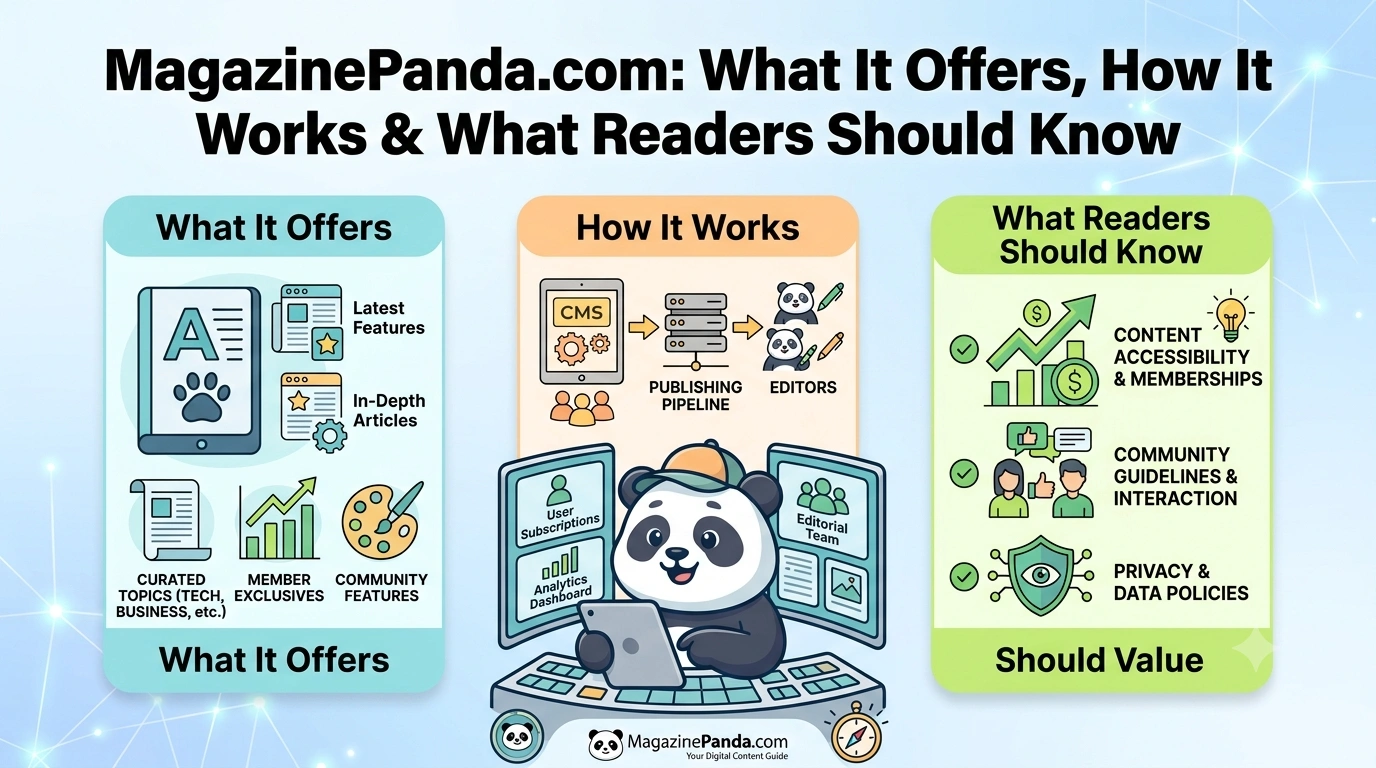
MagazinePanda.com: What It Offers, How It Works & What Readers Should Know.

Introduction
Digital publishing has changed what people expect from magazines.
Readers no longer have to wait for a monthly issue to discover an article about technology, lifestyle, business, education, travel, or emerging digital trends. They can search for a topic, open an article, compare several sources, and share useful information within minutes.
This has created a large ecosystem of online magazines and general-interest content platforms.
MagazinePanda.com is positioned within this broader digital publishing space.
The currently accessible MagazinePanda-branded website describes itself as a platform for blogs and articles covering a wide range of interests, with particular emphasis on diverse topics, analyses and reviews, and lifestyle content.
Its About page also presents MagazinePanda.com as a publication focused on informing, inspiring, and engaging readers through broad online content.
However, information about MagazinePanda varies across third-party sources, and similarly named domains also appear online. That makes it important to distinguish the website’s own descriptions from outside commentary.
This guide takes a practical look at MagazinePanda.com, its content model, reader experience, SEO potential, credibility considerations, and the factors readers and marketers should examine before relying on or working with an online publication.
What Is MagazinePanda.com?
MagazinePanda.com is presented as a broad digital publishing platform offering articles and blogs across multiple subject areas.
Unlike a specialist website that focuses exclusively on one topic, the MagazinePanda model is designed around variety.
The official site describes content ranging from lifestyle to technology, while its service page also mentions health, entertainment, reviews, current trends, food, travel, and home-related subjects.
This type of publication can appeal to readers who enjoy discovering different subjects from one website.
Instead of visiting:
- A technology website for technology
- A lifestyle publication for lifestyle
- A travel blog for travel
- A business site for business
a general digital publication can bring several categories together.
That convenience is one of the main attractions of multi-topic publishing.
MagazinePanda.com at a Glance
| Feature | Overview |
|---|---|
| Brand | MagazinePanda |
| Website discussed | MagazinePanda.com |
| Publishing model | Broad digital content |
| Primary formats | Articles and blogs |
| Content approach | Multi-topic |
| Mentioned areas | Lifestyle, technology, health, entertainment, reviews and more |
| Audience | General online readers |
| Main discovery methods | Search, direct visits, social sharing and recommendations |
| Best use | General information and topic discovery |
| Important consideration | Evaluate individual articles and sources |
The site’s own service description emphasizes diverse content, analyses and reviews, lifestyle material, and community interaction.
Why Digital Magazines Are Different From Print Magazines
Traditional magazines operate around publishing cycles.
An issue might be released:
- Weekly
- Monthly
- Quarterly
Digital publications do not have the same limitation.
An online article can be:
- Published immediately
- Updated later
- Linked to other articles
- Shared through social media
- Indexed by search engines
- Enhanced with images and video
- Accessed from smartphones
This makes digital magazines much more flexible.
It also changes how publishers compete.
In print, shelf space is limited.
Online, virtually unlimited content is available.
That means quality and usefulness become increasingly important differentiators.
MagazinePanda and the Multi-Topic Content Model
A multi-topic website has a simple advantage:
There is something for many different interests.
The accessible MagazinePanda site describes itself as offering a broad range of topics and says its content is intended to inform and inspire readers.
This approach can attract different types of readers.
For example:
Technology Reader
May be interested in:
- AI
- Software
- Digital trends
- Gadgets
Lifestyle Reader
May prefer:
- Wellness
- Food
- Home
- Personal interests
Travel Reader
May look for:
- Destination ideas
- Travel planning
- Experiences
- Guides
Business Reader
May search for:
- Business trends
- Productivity
- Digital tools
- Professional ideas
A broad publication can potentially serve all of these audiences.
Variety Is Useful, But Expertise Still Matters
There is an important distinction between covering a topic and being an authority on that topic.
A general website can explain a technology concept.
A specialist technology publication may have deeper technical expertise.
Similarly, a general website can discuss health information.
A medical institution or qualified healthcare professional may provide a much stronger source for diagnosis or treatment questions.
This does not make general-interest publications useless.
It simply means readers should understand the role of the content.
General articles are often useful for discovery and introductory understanding.
For high-stakes decisions, readers should continue to authoritative primary or specialist sources.
What Types of Content Can Readers Expect?
The current MagazinePanda-branded website highlights several broad content styles.
Diverse Topics
The platform describes articles covering multiple subjects, from lifestyle to technology.
Analyses and Reviews
Its services page highlights analyses and reviews intended to examine trends, products, and cultural topics in greater depth.
Lifestyle Content
The site specifically mentions lifestyle material involving areas such as wellness, food, travel, and home-related inspiration.
Community Engagement
The site also describes reader interaction through comments, shares, and discussions.
These descriptions show a magazine-style approach rather than a publication restricted to one specialized category.
MagazinePanda and Reader Experience
A digital publication has to compete for attention.
Readers may open an article and decide within seconds whether it is worth reading.
That makes page structure important.
A reader-friendly article should usually have:
- A clear title
- A short introduction
- Descriptive headings
- Short paragraphs
- Lists where appropriate
- Helpful examples
- Relevant visuals
- Clear conclusions
- Frequently asked questions
The objective is not simply to make an article look attractive.
The structure should help readers find and understand information faster.
Why Clear Headlines Matter
A headline should tell readers what they are going to get.
Compare:
Digital Publishing
with:
How Digital Publishing Is Changing the Way People Read Online
The second title communicates a clearer subject and benefit.
However, strong headlines should remain accurate.
A misleading headline may increase clicks temporarily but can reduce trust.
The best approach is:
Create curiosity without sacrificing accuracy.
MagazinePanda and Search Intent
Search engines are one of the biggest discovery channels for digital publications.
But people search for different reasons.
Understanding search intent helps publishers create better content.
Four Common Search Intents
Informational Intent
The user wants to learn.
Example:
“What is digital publishing?”
Navigational Intent
The user wants to find a specific website.
Example:
“MagazinePanda.com”
Commercial Investigation
The user wants to compare options.
Example:
“Best online publishing platforms”
Practical Intent
The user wants to accomplish something.
Example:
“How to start an online magazine”
A strong publication can create content for multiple stages of the reader journey.
Why Direct Answers Improve Content
Readers should not have to read 1,500 words before discovering the basic answer.
A useful structure is:
Direct answer → Explanation → Example → Deeper context
For example:
What Is MagazinePanda.com?
MagazinePanda.com is presented as a broad digital publishing platform offering articles and blogs across multiple interests, including lifestyle and technology.
The rest of the article can then explain its content model, reader experience, strengths, limitations, and credibility considerations.
This structure is useful for both humans and AI-powered answer systems.
MagazinePanda and AEO
Answer Engine Optimization (AEO) focuses on making information easy for answer engines to understand.
Useful practices include:
- Question-based headings
- Direct answers
- Short definitions
- Structured lists
- Tables
- FAQs
- Clear terminology
For example:
Is MagazinePanda.com a Digital Magazine?
MagazinePanda.com is positioned as an online content and magazine-style publishing platform rather than a traditional print magazine.
This gives an answer engine a concise response while providing additional context for human readers.
MagazinePanda and GEO
Generative Engine Optimization, or GEO, focuses on creating information that can be accurately interpreted by AI-powered systems.
Useful GEO practices include:
Clear Definitions
Explain important terms directly.
Structured Content
Use logical headings and sections.
Specific Information
Avoid vague statements.
Evidence
Support important claims with reliable sources.
Context
Explain why information matters.
Self-Contained Answers
Make individual sections understandable without requiring the reader to search elsewhere.
The goal should not be to manipulate AI systems.
It should be to make information clear, useful, structured, and verifiable.
MagazinePanda and E-E-A-T
E-E-A-T stands for:
Experience, Expertise, Authoritativeness, and Trustworthiness.
These principles are particularly important for broad digital publications.
Experience
Does the writer demonstrate first-hand knowledge?
Expertise
Does the writer understand the subject?
Authoritativeness
Does the publication provide credible information and appropriate sources?
Trustworthiness
Can readers understand where the information comes from and whether it has been reviewed?
The importance of these factors changes depending on the topic.
A personal travel story may rely strongly on first-hand experience.
A medical article requires much stronger professional expertise.
A financial article may require reliable financial data and appropriate disclosures.
Why Author Transparency Matters
Readers should ideally be able to identify who created an article.
A useful author profile can contain:
- Author name
- Professional background
- Relevant experience
- Areas of expertise
- Published work
- Credentials where appropriate
This is especially useful when the article deals with a specialized topic.
A publication becomes easier to evaluate when readers can understand the person behind the information.
Publication Dates Are Important
Online information can become outdated.
This is especially true for:
- Technology
- Software
- Travel rules
- Financial products
- Business regulations
- Laws
- Consumer products
An article written several years ago may still be useful.
But its information should not automatically be assumed to remain current.
Readers should look for:
Published date + Updated date + Current sources
when available.
Why Evergreen Content Still Needs Updates
Evergreen content is designed to remain useful for a long time.
Examples include:
- Beginner guides
- Definitions
- Tutorials
- Checklists
- Educational explainers
But even evergreen topics can change.
For example:
A guide to using a software product may become outdated after a major interface change.
A travel guide may need new information after a regulation changes.
A technology explainer may need revision when terminology evolves.
Therefore:
Evergreen does not mean permanent.
MagazinePanda and Content Quality
A successful digital publication should focus on the usefulness of its articles rather than simply the number of pages it publishes.
High-quality content generally provides:
- A clear purpose
- Accurate information
- Relevant context
- Useful examples
- Logical organization
- Appropriate sources
- Original perspective
- Easy readability
The article should answer:
What will the reader know after finishing this page that they did not know before?
That is a much better quality test than simply counting words.
Generic Content vs. Useful Content
Consider two articles about artificial intelligence.
Article A
AI is changing the world. AI is useful for businesses. AI is becoming popular.
Article B
AI can automate repetitive business tasks such as sorting customer inquiries, summarizing documents, and organizing routine information. However, businesses still need human review when decisions involve sensitive or consequential information.
Article B provides:
- A specific explanation
- Examples
- Context
- A limitation
That is what makes content more useful.
MagazinePanda and Visual Communication
Digital magazines can use more than written content.
Relevant visuals can improve comprehension.
Images
Useful for introducing subjects and providing context.
Infographics
Useful for:
- Statistics
- Comparisons
- Timelines
- Processes
Charts
Useful when information involves measurable data.
Video
Useful for:
- Demonstrations
- Tutorials
- Interviews
- Product explanations
Diagrams
Useful for explaining systems and processes.
Visuals should support the content.
They should not simply be added to make a page look fuller.
Mobile-Friendly Publishing
Modern digital content must work well on smaller screens.
A mobile-friendly article should provide:
- Readable text
- Clear headings
- Short paragraphs
- Responsive images
- Simple navigation
- Fast loading
- Easy-to-tap links
Even excellent content can lose readers if the page is difficult to use.
MagazinePanda and Content Repurposing
One strong article can become multiple pieces of content.
For example:
Main Article
How Artificial Intelligence Is Changing Online Publishing
Social Post
Five ways AI is changing content creation.
Video
A short explanation of AI-assisted publishing.
Infographic
The digital publishing workflow.
Newsletter
Key insights from the article.
FAQ
Answers to common AI publishing questions.
This strategy helps publishers reach readers with different content preferences.
Building Topic Clusters
A multi-topic publication can improve its organization through topic clusters.
Suppose MagazinePanda creates a technology section.
A central article could cover:
Understanding Artificial Intelligence
Supporting articles could include:
- What Is Generative AI?
- How AI Assistants Work
- AI in Business
- AI Productivity Tools
- AI Search Explained
- AI Safety Basics
These articles can link to one another naturally.
The result is a more useful content library.
Why Internal Linking Matters
Internal links can help readers discover related information.
For example, an article about digital marketing might link to:
- SEO basics
- Social media marketing
- Content marketing
- AI marketing tools
- Search intent
This creates a logical journey.
It can also help search engines understand the relationships between pages.
The best internal links are based on context and reader usefulness, not arbitrary keyword placement.
MagazinePanda and AI-Assisted Publishing
Artificial intelligence can help publishers perform repetitive tasks.
Potential uses include:
- Brainstorming
- Outlining
- Research organization
- Summarization
- Translation
- Editing
- Content repurposing
But AI-generated information can contain errors.
Common problems include:
- Incorrect facts
- Outdated information
- Missing context
- Repetitive writing
- Unsupported claims
Therefore:
AI can improve production efficiency, but human review remains essential.
A Responsible AI Content Workflow
A practical process is:
Step 1: Research
Find reliable information.
Step 2: Define the Audience
Know who the article is for.
Step 3: Identify the Question
Understand what the reader actually wants.
Step 4: Build the Outline
Organize the answer.
Step 5: Draft
Create the initial article.
Step 6: Verify
Fact-check important claims.
Step 7: Edit
Improve clarity and originality.
Step 8: Add Evidence
Include appropriate sources.
Step 9: Optimize
Improve metadata, headings, links, and visuals.
Step 10: Publish and Update
Monitor the article and refresh it when necessary.
This approach treats AI as a tool rather than a replacement for editorial judgment.
How Readers Can Evaluate MagazinePanda Articles
A useful evaluation process takes only a few minutes.
1. Check the Author
Is the author identified?
2. Check the Date
Is the information recent enough?
3. Check the Sources
Are important claims supported?
4. Check the Language
Does the article distinguish fact from opinion?
5. Compare Important Claims
Do reliable external sources agree?
6. Consider the Topic
Does the article involve health, finance, law, safety, or another high-stakes subject?
If yes, use specialist or primary sources as the final reference.
Is MagazinePanda.com Reliable?
There is no single answer that should apply to every article.
A publication’s reliability should be assessed at the article level.
The official MagazinePanda-branded website states that it prioritizes accuracy, relevance, quality, and trustworthy content.
However, third-party sources provide different descriptions of the domain and its current operation. One recent third-party review, for example, raises concerns about author transparency and SEO visibility, while other sources describe MagazinePanda more positively as a broad digital publishing platform.
These differences are precisely why readers should avoid relying on promotional claims or third-party summaries alone.
For important information, inspect:
- The original article
- Author information
- Publication date
- Supporting evidence
- Primary sources
- Editorial disclosures
MagazinePanda and SEO
If you are evaluating MagazinePanda for SEO or content marketing, domain-level metrics should not be the only consideration.
Look at:
Topical Relevance
Does the publication genuinely cover your subject?
Audience Fit
Would its readers care about your content?
Organic Visibility
Does the website rank for relevant queries?
Content Quality
Are articles useful and original?
Editorial Standards
Are authors and sources transparent?
Page-Level Relevance
Would the specific article attract the right audience?
Long-Term Value
Could the page continue attracting useful visitors?
A website with a large domain score is not automatically a valuable publishing opportunity.
Why Domain Authority Alone Is Not Enough
SEO platforms may report:
- Domain Authority
- Domain Rating
- Backlinks
- Organic traffic estimates
- Keyword rankings
These metrics can help with research.
But they do not automatically prove:
- Reader trust
- Editorial expertise
- Audience relevance
- Content quality
- Business value
A relevant publication with genuine readers can be more useful than a website with impressive metrics but little meaningful audience connection.
MagazinePanda and Guest Posting
If you are considering MagazinePanda for guest publishing, verify its current editorial policy before submitting anything.
Look for:
- Submission guidelines
- Author requirements
- Link policies
- Sponsored-content rules
- Payment terms
- Copyright terms
- Editorial review process
Do not assume that a website accepts guest posts simply because third-party websites describe it as a publishing platform.
The current official pages reviewed here emphasize content, articles, reviews, lifestyle material, and community engagement, but they do not by themselves establish a current guest-posting policy.
Common Digital Publishing Mistakes
Publishing Without a Clear Audience
Trying to write for everyone can make an article useful to nobody.
Writing Generic Summaries
Repeating information already available across hundreds of websites adds limited value.
Ignoring Expertise
Specialist topics require appropriate knowledge.
Failing to Update Articles
Old information can become misleading.
Overusing Keywords
Search optimization should never make an article unnatural.
Relying Entirely on AI
Automation without fact-checking can introduce errors.
Confusing Traffic With Value
A high number of visitors does not necessarily mean readers found the content useful.
How a Digital Publication Can Build Stronger Trust
A publication can strengthen credibility through several practical elements.
Clear About Page
Explain who operates the publication and what it aims to provide.
Author Profiles
Give readers context about contributors.
Editorial Guidelines
Explain how content is created and reviewed.
Source Transparency
Support important claims.
Correction Policy
Correct significant errors rather than silently leaving inaccurate information online.
Contact Information
Provide a way for readers to reach the publication.
Privacy and Terms Pages
Explain how the website handles users and content.
Advertising Disclosure
Clearly distinguish editorial content from paid promotion.
These signals help readers understand the publication better.
The Future of Online Magazine Publishing
Digital publishing will continue to change.
Several trends are likely to influence websites like MagazinePanda.
AI-Assisted Research
AI will increasingly help publishers organize and process information.
Multimedia Articles
Articles will combine text with images, audio, video, charts, and interactive features.
Search Beyond Google
Readers increasingly discover information through social platforms, recommendation systems, communities, and AI-powered search experiences.
Greater Demand for Originality
Generic information is easier to produce than ever.
That makes first-hand experience, original research, expert commentary, and unique examples more valuable.
Stronger Trust Expectations
Readers will increasingly want to know:
Who wrote this?
Where did the information come from?
Is it current?
Can I verify it?
Digital publishers that answer these questions clearly will have a stronger foundation for long-term growth.
A Practical Content Strategy for MagazinePanda
A sustainable publishing process can follow these steps:
Step 1: Find a Genuine Question
Start with something readers actually want to know.
Step 2: Understand Search Intent
Determine whether the user wants information, comparison, guidance, or a specific website.
Step 3: Research
Use credible and relevant sources.
Step 4: Define the Main Answer
Know what the reader should remember.
Step 5: Create the Outline
Build logical sections.
Step 6: Write Clearly
Use simple and natural language.
Step 7: Add Original Value
Include examples, experience, analysis, or useful comparisons.
Step 8: Verify Claims
Fact-check important information.
Step 9: Add Supporting Media
Use images, charts, or video when they improve understanding.
Step 10: Optimize
Improve titles, metadata, headings, links, and page structure.
Step 11: Publish
Make the content accessible across devices.
Step 12: Review and Update
Refresh information as circumstances change.
Measuring Content Success
The right metric depends on the purpose of the article.
| Metric | What It Indicates |
|---|---|
| Impressions | Search visibility |
| Clicks | Initial interest |
| Organic traffic | Search discovery |
| Engagement | Reader interaction |
| Time on page | Content consumption |
| Shares | Audience resonance |
| Returning visitors | Reader loyalty |
| Newsletter signups | Audience growth |
| Conversions | Desired actions |
Traffic should not be treated as the only measure of success.
A useful guide may attract fewer visitors but provide much more value to the people who read it.
MagazinePanda.com: Potential Strengths
Broad Content Appeal
The official site positions MagazinePanda around diverse topics rather than one narrow category.
Multiple Content Formats
The website highlights articles, blogs, analyses, reviews, and lifestyle content.
Reader-Oriented Positioning
The site emphasizes accessible information and engaging content.
Flexible Publishing Model
A broad digital platform can adapt to changing reader interests and online trends.
Content Discovery
Readers can potentially explore several subject areas from one publication.
MagazinePanda.com: Important Considerations
Similar Domain Names
Multiple websites and third-party pages currently discuss MagazinePanda under similar names or domains. This means readers should confirm they are evaluating the intended website.
Conflicting Third-Party Descriptions
Outside sources do not always agree about the site’s current structure, authority, or purpose.
Broad Subject Coverage
A multi-topic approach makes editorial expertise particularly important.
High-Stakes Topics Require Extra Verification
Health, finance, law, safety, and investment information should be checked against authoritative sources.
SEO Claims Need Independent Verification
Third-party SEO metrics can change and may not reflect actual reader value.
Frequently Asked Questions
What is MagazinePanda.com?
MagazinePanda.com is presented as a broad digital publishing platform offering articles and blogs across multiple interests, including lifestyle and technology. Its official website also describes analyses, reviews, and lifestyle content as part of its publishing approach.
What topics does MagazinePanda cover?
The current MagazinePanda-branded website describes diverse content spanning areas such as technology, lifestyle, health, entertainment, food, travel, home-related topics, reviews, and broader trends.
Is MagazinePanda.com a traditional magazine?
No. It is better understood as an online magazine-style or digital publishing platform. Its content is delivered through the web rather than through a traditional printed magazine format.
Is MagazinePanda.com reliable?
Reliability should be evaluated article by article. Readers should examine authorship, publication dates, supporting sources, editorial transparency, and whether important claims agree with authoritative sources.
Can I use MagazinePanda for research?
It can be useful for general information and topic discovery. For academic, medical, financial, legal, or other high-stakes research, use primary sources and recognized specialist authorities as the final reference.
Can I publish a guest post on MagazinePanda.com?
Do not assume that guest publishing is currently available. Check the website directly for current submission rules, editorial requirements, link policies, and contact information before submitting content.
Does MagazinePanda cover technology and lifestyle?
Yes. The official MagazinePanda website specifically describes content covering lifestyle and technology among its diverse subject areas.
How should I evaluate a MagazinePanda article?
Check the author, publication or update date, sources, factual claims, and overall relevance. If the subject can affect health, finances, legal rights, safety, or other important decisions, verify the information with authoritative sources.
Final Thoughts
MagazinePanda.com represents the broad digital-magazine model that has become increasingly common across the internet.
Its current website presents a content strategy built around variety, with articles and blogs spanning different interests and with particular emphasis on areas such as technology, lifestyle, analyses, reviews, and general-interest information.
That broad approach has a clear advantage.
Readers can discover different subjects from one online destination.
But it also creates an important responsibility.
When a website covers many fields, readers should not automatically assume that every article has the same level of expertise.
Instead, evaluate the information based on:
Who wrote it?
When was it published?
What evidence supports it?
Does the source have relevant expertise?
Can the claim be independently verified?
For everyday topics, a well-structured digital article can be a useful starting point.
For high-stakes subjects, it should be treated as one source among several.
For marketers and SEO professionals, the same principle applies.
Do not evaluate MagazinePanda—or any other publishing website—solely through domain metrics.
Look at:
Topical relevance + Audience fit + Content quality + Search visibility + Editorial standards + Long-term value.
For publishers, the opportunity is even broader.
The internet no longer has a shortage of content.
It has a shortage of content worth trusting.
The next generation of successful digital publications will therefore need to do more than publish frequently.
They will need to explain clearly, research responsibly, demonstrate expertise, update information, and give readers a genuine reason to return.
That is ultimately what transforms a collection of web pages into a useful digital publication.