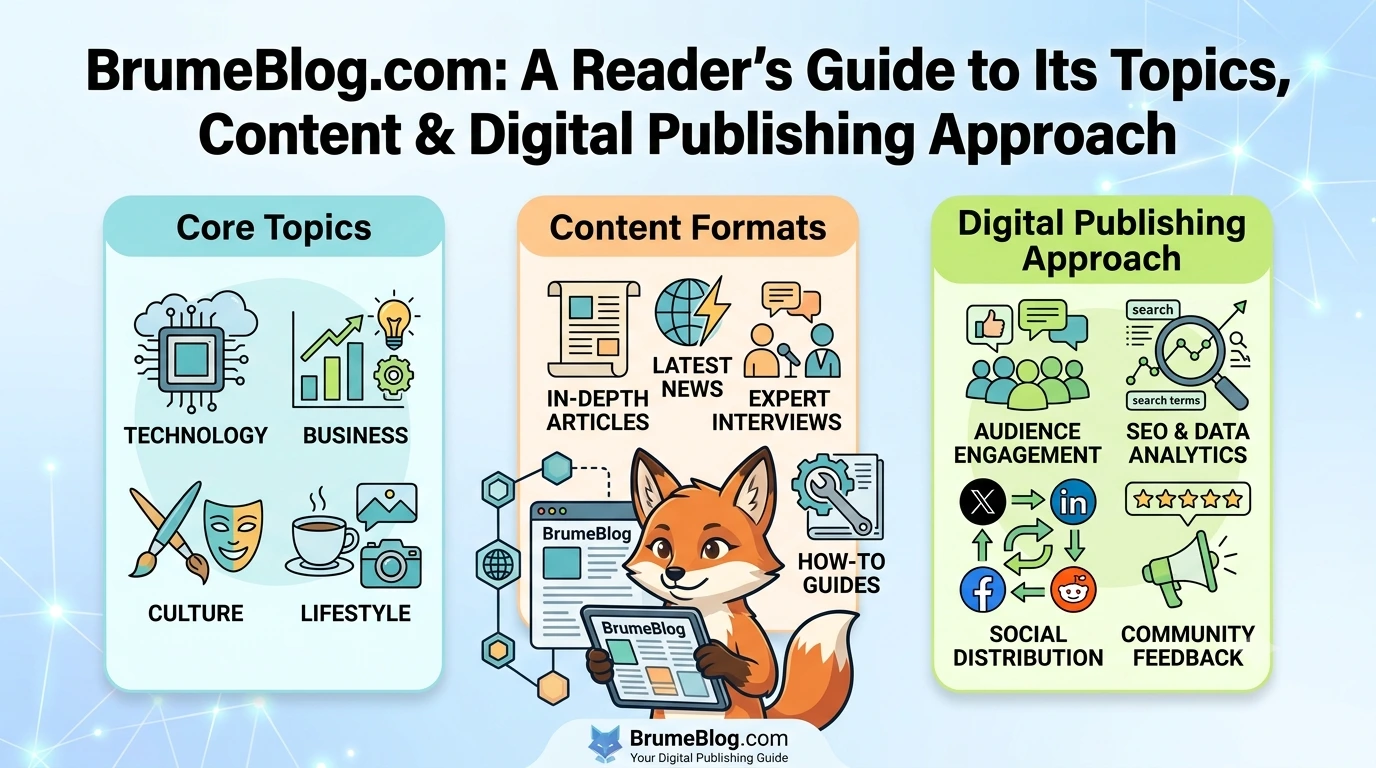
BrumeBlog.com: A Reader’s Guide to Its Topics, Content & Digital Publishing Approach.

Introduction
The internet has changed the way people discover information.
Instead of relying on newspapers, television, printed magazines, or specialized reference books, readers can now search for answers whenever they need them. A single search can lead someone from a technology article to a travel guide, a business explanation, a legal overview, or a lifestyle article within minutes.
This has created a growing category of multi-topic digital publications.
BrumeBlog.com is one example of this model.
The current Brume Blog website organizes content across a wide range of categories, including AI, business, crypto, education, fashion, finance, health, home, law, lifestyle, pets, real estate, technology, trading, travel, websites, and gaming-related sections.
Recent posts also show the breadth of its publishing approach, with articles covering subjects such as legal issues, consumer rights, unknown phone numbers, travel, workplace concerns, and technology-related topics.
But a broad content library raises an important question:
How should readers evaluate information when one publication covers so many different subjects?
This guide explores BrumeBlog.com from that perspective—looking at its content model, categories, reader experience, search intent, E-E-A-T, AI-assisted publishing, SEO value, and practical ways to evaluate its articles.
What Is BrumeBlog.com?
BrumeBlog.com is a multi-category online publishing website that provides articles across numerous subject areas.
Rather than focusing exclusively on one niche, the website brings multiple categories together under one domain.
Its current category structure includes:
- AI
- Business
- Crypto
- Education
- Fashion
- Finance
- Games
- Health
- Home
- Law
- Lifestyle
- Online Games
- Pets
- Real Estate
- Technology
- Trading
- Travel
- Websites
The site’s own description also presents BrumeBlog.com as a broad magazine-style platform covering subjects such as fashion, lifestyle, entertainment, technology, business, and sports.
This makes BrumeBlog best understood as a general-interest digital content platform rather than a narrowly specialized publication.
BrumeBlog.com at a Glance
| Feature | Overview |
|---|---|
| Website | BrumeBlog.com |
| Content model | Multi-topic digital publishing |
| Primary format | Online articles |
| Topic range | Broad |
| Audience | General online readers |
| Main categories | Technology, business, health, travel, finance, lifestyle and more |
| Content style | Informational and practical |
| Best use | General research and topic discovery |
| Important consideration | Verify specialist and high-stakes information independently |
The current homepage shows a mixture of newer and older articles, while the category pages demonstrate the site’s broad editorial structure.
Why Multi-Topic Websites Have Become Popular
A traditional niche blog concentrates on one subject.
For example:
A technology website may publish only about software and gadgets.
A travel website may focus entirely on destinations and trip planning.
A finance website may cover money and investment topics.
A multi-topic website takes a different approach.
It attempts to serve readers interested in several subjects from one location.
That model has several advantages.
Convenience
Readers can explore different subjects without visiting multiple websites.
Variety
A single website can cover changing interests.
Broader Content Discovery
Readers may discover subjects they were not originally searching for.
Flexible Publishing
The publisher can respond to different trends and audience questions.
But there is also an important limitation:
Broad coverage does not automatically equal deep expertise.
Breadth vs. Topical Authority
This is one of the most important concepts for understanding a multi-category website.
Imagine a website that publishes:
- 100 technology articles
- 100 travel articles
- 100 finance articles
- 100 health articles
It has impressive breadth.
But readers may still ask:
Who actually has expertise in each of these subjects?
A specialist publication can sometimes demonstrate authority more easily because its writers, editorial resources, and content history are concentrated around one field.
A multi-topic site needs to work harder to demonstrate expertise across different categories.
What Does BrumeBlog Publish?
The current website demonstrates a broad range of content.
Recent homepage articles include topics such as:
- Legal issues
- Consumer rights
- Unknown phone numbers
- Criminal-law terminology
- Workplace injury claims
- Travel
- Housing and moving
- Technology and AI-related subjects
This broad mix illustrates the site’s general-interest publishing approach.
The category structure expands this further into technology, finance, health, education, lifestyle, pets, real estate, travel, trading, and other areas.
Technology Content
Technology is one of the major areas associated with BrumeBlog.
Technology publishing can cover:
- Artificial intelligence
- Apps
- Software
- Digital tools
- Cybersecurity
- Gadgets
- Emerging technologies
- Online services
The challenge with technology content is freshness.
A technology article can become outdated quickly because:
- Software changes
- Product specifications change
- Features are added or removed
- Companies change policies
- New competitors appear
Technology content therefore benefits from visible publication and update dates.
Business Content
Business is another broad category.
Business articles can address:
- Entrepreneurship
- Workplace issues
- Productivity
- Business operations
- Digital business
- Marketing
- Professional development
Readers should distinguish general business education from professional advice.
An article explaining a business concept can be useful for learning.
A major legal, tax, financial, or investment decision may require specialist guidance.
Finance and Trading Content
Finance and trading are areas where readers should be particularly careful.
General articles can help explain:
- Financial terminology
- Budgeting concepts
- Saving
- Investing basics
- Trading terminology
- Business finance
However, financial information can directly influence real-world decisions.
Readers should therefore verify important claims against authoritative sources and avoid treating general online articles as personalized financial advice.
Health Content
Health is another category that requires a higher level of scrutiny.
A general article can be useful for:
- Understanding terminology
- Learning about a topic
- Preparing questions for a healthcare professional
- Finding subjects for further research
But health information should not automatically be treated as medical advice.
For diagnosis, treatment, medication, or urgent concerns, readers should rely on qualified healthcare professionals and authoritative medical sources.
Travel Content
Travel articles can be useful for inspiration and planning.
Potential subjects include:
- Destinations
- Road trips
- Travel planning
- Attractions
- Transportation
- Accommodation
- Local experiences
However, travel information can change quickly.
Readers should verify:
- Entry requirements
- Visa rules
- Transportation schedules
- Prices
- Opening hours
- Local regulations
- Safety advisories
Official sources should take priority for time-sensitive travel requirements.
Education Content
Educational content is particularly useful when it simplifies complicated subjects.
A strong educational article should:
- Define the topic.
- Explain the main concept.
- Use simple examples.
- Introduce important terminology.
- Provide additional resources where necessary.
The objective should be understanding rather than simply filling a page with information.
Lifestyle and Home Content
Lifestyle and home topics can cover everyday interests and practical questions.
Examples include:
- Home improvement
- Smart homes
- Cleaning
- Organization
- Lifestyle habits
- Personal interests
- Household decisions
This category can benefit strongly from first-hand experience.
For example, an article explaining how to clean a particular material can be more useful when it reflects genuine practical experience rather than generic instructions.
BrumeBlog and Reader Intent
One reason broad websites can attract readers is that they can target many different search intents.
A reader may arrive through an informational query.
Another may search for a practical solution.
Someone else may already know the brand.
Understanding these differences is essential.
Four Major Search Intents
Informational
The reader wants to learn.
Example:
“What is a felony?”
Navigational
The reader wants to find a particular website.
Example:
“BrumeBlog.com”
Commercial Investigation
The reader wants to compare choices.
Example:
“Best online business tools”
Practical or Transactional
The reader wants to complete an action.
Example:
“How to file a workplace injury claim”
Different intents require different content structures.
Why Direct Answers Matter
Readers increasingly want answers quickly.
A strong article should provide the main answer near the beginning.
A useful structure is:
Direct answer → Explanation → Example → Deeper context
For example:
What Is BrumeBlog.com?
BrumeBlog.com is a multi-category digital publishing website covering subjects such as technology, business, health, finance, travel, lifestyle, and other areas.
Then the article can explain how the site is structured and how readers should evaluate individual articles.
This is useful for both humans and answer engines.
BrumeBlog and AEO
Answer Engine Optimization (AEO) focuses on making content easy for search and answer systems to interpret.
AEO-friendly content often uses:
- Clear questions
- Direct answers
- Descriptive headings
- Concise explanations
- Structured lists
- Tables
- FAQs
For example:
Question: What is a multi-topic blog?
Answer: A multi-topic blog is a website that publishes content across several unrelated or loosely connected subject categories rather than concentrating on one narrow niche.
Then the article can provide examples and context.
BrumeBlog and GEO
Generative Engine Optimization, or GEO, focuses on making content understandable to AI-powered information systems.
Good GEO practices include:
- Clear definitions
- Specific terminology
- Logical organization
- Self-contained explanations
- Reliable evidence
- Concise answers
- Contextual information
The goal should not be to manipulate AI systems.
The goal should be to make information clear, structured, and useful enough to be understood correctly.
BrumeBlog and E-E-A-T
E-E-A-T stands for:
Experience, Expertise, Authoritativeness, and Trustworthiness.
These concepts are especially relevant to broad publications.
Experience
Does the writer demonstrate first-hand knowledge?
Expertise
Does the author have relevant knowledge of the subject?
Authoritativeness
Does the publication demonstrate credibility?
Trustworthiness
Can readers understand where information came from and how it was produced?
The importance of each factor depends on the topic.
A personal travel experience may rely heavily on experience.
A medical article requires substantially stronger expertise and sourcing.
Why Author Information Matters
A byline can help readers evaluate content.
The current Brume Blog homepage displays named authors on several recent articles, including Devin Haney and Shivi Hyde.
That is useful because it gives readers more information than completely anonymous content.
For specialist subjects, stronger author profiles can provide additional context, such as:
- Professional background
- Areas of expertise
- Relevant experience
- Published work
- Credentials where appropriate
The more consequential the topic, the more important these signals become.
Publication Dates and Freshness
Digital information can become outdated.
The current Brume Blog homepage displays publication dates for recent articles, including posts from August 2026.
Dates help readers answer an important question:
How current is this information?
This matters particularly for:
- Technology
- Law
- Finance
- Travel
- Consumer rights
- Software
- Business regulations
An old article is not necessarily bad.
But its information may need verification.
Why Updating Old Articles Matters
Suppose an article explains a software application.
The software releases a major update.
If the article is never reviewed, some of its instructions may become inaccurate.
The same applies to:
- Laws
- Regulations
- Prices
- Travel rules
- Financial products
- Technology specifications
A good digital publishing strategy should therefore include periodic content reviews.
BrumeBlog and Internal Linking
A multi-topic website can become more useful when related articles are connected.
For example, a technology cluster might contain:
Main Guide
Understanding Artificial Intelligence
Supporting Articles
- What Is Generative AI?
- How AI Assistants Work
- AI Productivity Tools
- AI in Business
- AI Safety Basics
Internal links help readers move naturally between related subjects.
They can also help search engines understand the relationship between pages.
Building Topic Clusters
A topic cluster is a group of connected articles covering one subject from multiple angles.
For example:
Travel
- Beginner travel planning
- Budget travel
- Road trips
- Travel insurance
- Packing guides
- Destination guides
The cluster provides more depth than isolated articles.
For a multi-topic website, building strong clusters can help balance broad coverage with meaningful topical depth.
BrumeBlog and Content Quality
A good article should provide more than words.
It should provide value.
Useful content can:
- Explain
- Solve
- Compare
- Guide
- Inform
- Demonstrate
- Help readers make decisions
A page that simply repeats information available everywhere may have limited value even if it is technically optimized for search.
What Makes an Article Useful?
Consider these five questions:
1. Does it answer the reader’s question?
If not, the article needs improvement.
2. Does it provide enough context?
Facts without context can be difficult to understand.
3. Does it use examples?
Examples turn abstract information into something practical.
4. Are important claims supported?
Readers need evidence for consequential information.
5. Does it offer something beyond generic summaries?
Original insights, experience, research, or useful organization can add value.
AI and BrumeBlog-Style Publishing
Artificial intelligence is changing how online articles are produced.
AI can assist with:
- Topic research
- Brainstorming
- Outlining
- Summarization
- Translation
- Editing
- Content repurposing
But AI-generated information can contain errors.
Potential problems include:
- Incorrect facts
- Outdated information
- Missing context
- Repetitive language
- Unsupported claims
Human review therefore remains important.
A Better AI-Assisted Publishing Process
A responsible workflow looks like this:
Step 1: Research
Gather reliable information.
Step 2: Define the Audience
Understand who needs the article.
Step 3: Identify Search Intent
Determine what the reader is actually looking for.
Step 4: Create an Outline
Organize the answer logically.
Step 5: Draft
Use human writing and appropriate AI assistance.
Step 6: Fact-Check
Verify important claims.
Step 7: Edit
Improve clarity, originality, and readability.
Step 8: Review
Check sources, dates, links, and formatting.
Step 9: Publish
Make the content easy to access.
Step 10: Update
Refresh information when necessary.
AI can improve efficiency.
Editorial responsibility still belongs to people.
BrumeBlog and Visual Content
Digital publications can use more than text.
Relevant visuals can help readers:
- Understand concepts
- Compare information
- Follow processes
- Scan long articles
- Remember important ideas
Useful formats include:
Images
For context and visual explanation.
Infographics
For statistics and comparisons.
Charts
For data.
Videos
For demonstrations and tutorials.
Diagrams
For processes and systems.
Visual content should support the article rather than exist only for decoration.
Mobile-Friendly Publishing
A large percentage of online reading occurs on mobile devices.
That makes mobile presentation essential.
A reader-friendly page should have:
- Readable typography
- Short paragraphs
- Responsive layouts
- Clear navigation
- Fast-loading images
- Easy-to-tap links
- Adequate spacing
Good information can still perform poorly if the page is difficult to read.
BrumeBlog and Content Repurposing
A single article can become several pieces of content.
For example:
Article
How Artificial Intelligence Is Changing Business
Social Post
Five ways AI is changing everyday business.
Video
A short explanation of AI in business.
Infographic
AI applications by business function.
Newsletter
The week’s key AI insights.
FAQ
Answers to common questions.
This allows publishers to reach readers through multiple channels while building around the same core idea.
BrumeBlog for General Readers
The broad structure of BrumeBlog can be useful for readers who enjoy discovering different subjects.
Someone might arrive looking for information about:
Travel
and later discover:
Technology
or:
Lifestyle
or:
Business
This type of cross-topic discovery is one of the advantages of a general-interest publication.
However, readers should still move to specialist sources when a subject requires expert-level information.
BrumeBlog for Beginners
General-interest websites can be particularly useful at the beginning of a research journey.
For example:
Step 1: Read a beginner-friendly explanation.
Step 2: Identify unfamiliar terms.
Step 3: Search for authoritative sources.
Step 4: Compare different explanations.
Step 5: Make a decision only after checking important facts.
This turns a general article into a starting point rather than the only source of information.
When Should Readers Verify Information?
Independent verification is especially important for:
- Medical information
- Financial advice
- Legal information
- Tax rules
- Government policies
- Travel requirements
- Safety instructions
- Investment decisions
- Cybersecurity recommendations
For these subjects, readers should consult appropriate primary or specialist sources.
BrumeBlog and SEO Research
If you are evaluating BrumeBlog for SEO, guest posting, or content placement, do not rely on one metric.
Look at:
Topical Relevance
Does the website cover your subject naturally?
Audience Fit
Would its readers actually care about your content?
Organic Visibility
Does the site rank for meaningful queries?
Content Quality
Are the existing articles useful and well researched?
Editorial Standards
Are authors and links handled responsibly?
Page-Level Relevance
Would the article itself attract the right audience?
Long-Term Value
Could the content continue generating useful visits?
These factors are more meaningful than a single domain score.
Domain Metrics Are Not the Whole Story
SEO platforms may provide metrics such as:
- Domain Authority
- Domain Rating
- Backlinks
- Estimated traffic
- Keyword rankings
These can help with preliminary research.
But they do not automatically prove:
- Reader trust
- Editorial quality
- Expertise
- Audience relevance
- Business value
A relevant, trustworthy publication can sometimes be more valuable than a website with impressive numbers but little topical connection.
BrumeBlog and Guest Posting
If you are considering publishing an article on BrumeBlog or a similar website, evaluate the opportunity carefully.
A useful guest article should:
- Match the publication’s audience
- Provide original information
- Avoid excessive promotion
- Use natural links
- Follow editorial requirements
- Contribute something useful
Before submitting, confirm:
- Whether submissions are currently accepted
- Whether links are allowed
- Whether payment is involved
- Who owns the published article
- Whether edits are permitted
- Whether sponsored content is clearly labeled
Policies can change, so they should be verified directly.
Common Mistakes Multi-Topic Websites Should Avoid
Covering Too Many Topics Without Depth
A large category list does not automatically create authority.
Publishing Generic Articles
Readers can find generic summaries everywhere.
Ignoring Author Expertise
Specialist topics need knowledgeable contributors.
Failing to Update Content
Old information can become misleading.
Overusing Keywords
Natural language is more useful than keyword repetition.
Relying Too Heavily on AI
AI should support the editorial workflow, not replace fact-checking.
Publishing for Traffic Alone
Traffic without reader value rarely creates lasting loyalty.
How BrumeBlog Can Build Stronger Topical Authority
A multi-category website can strengthen its content strategy by focusing on depth within selected areas.
Step 1: Identify Core Categories
Choose the subjects where the publication wants to build authority.
Step 2: Build Topic Clusters
Create connected articles rather than isolated posts.
Step 3: Strengthen Author Profiles
Show relevant experience and expertise.
Step 4: Add Reliable Sources
Support important factual claims.
Step 5: Update Existing Content
Review older articles regularly.
Step 6: Add First-Hand Insights
Use real experiences, examples, interviews, or original research.
Step 7: Improve Internal Linking
Connect related content naturally.
Step 8: Remove or Improve Weak Content
A smaller high-quality library can be more valuable than a large collection of thin pages.
The Future of Multi-Topic Digital Publishing
The online publishing environment is changing quickly.
Several developments are likely to influence websites like BrumeBlog.
AI-Assisted Content Creation
AI will continue to help with research, organization, and production.
Search Diversification
Readers increasingly discover information through traditional search, social networks, recommendation systems, and AI-powered tools.
First-Hand Experience
Original experience can become more valuable as generic content becomes easier to generate.
Multimedia Publishing
Articles can increasingly combine text, images, video, audio, and interactive elements.
Stronger Trust Requirements
Readers need clearer evidence that information is accurate.
Topical Depth
Broad websites will need meaningful depth rather than simply accumulating categories.
A Practical Content Strategy for BrumeBlog
A sustainable publishing process could follow this framework:
1. Choose a Real Reader Question
Start with a genuine information need.
2. Identify the Search Intent
Understand why the reader is searching.
3. Research the Topic
Use reliable and relevant sources.
4. Define the Main Answer
Determine what readers should remember.
5. Create the Outline
Build a logical structure.
6. Write for Humans
Use natural, accessible language.
7. Add Original Value
Include examples, experience, analysis, or useful comparisons.
8. Verify Important Claims
Fact-check before publication.
9. Optimize the Page
Improve title, headings, metadata, internal links, and visuals.
10. Publish
Make the article accessible across devices.
11. Measure Performance
Review traffic, engagement, and reader behavior.
12. Update
Refresh useful content as information changes.
Measuring Content Performance
Traffic is only one part of content performance.
| Metric | What It Can Tell You |
|---|---|
| Impressions | Visibility |
| Clicks | Initial interest |
| Organic traffic | Search discovery |
| Engagement | Reader interaction |
| Time on page | Content consumption |
| Shares | Audience resonance |
| Returning visitors | Loyalty |
| Newsletter signups | Audience growth |
| Conversions | Desired actions |
The most valuable metric depends on the article’s purpose.
A guide may be successful because it solves a reader’s problem.
A commercial article may be successful because it generates leads.
A news-style article may be successful because it attracts timely attention.
BrumeBlog: Potential Strengths
Broad Subject Coverage
The current category structure covers many areas, giving readers a wide range of topics to explore.
Regular New Content
The homepage currently displays multiple recent articles published in August 2026.
Multiple Reader Intents
The site’s broad topic range allows it to address informational, practical, and discovery-oriented searches.
Flexible Content Model
A multi-topic publication can adapt its content strategy as reader interests change.
Accessible Information
General-interest content can serve as a starting point for readers who are unfamiliar with a subject.
BrumeBlog: Important Considerations
Broad Coverage
Covering many categories creates a challenge around demonstrating deep expertise in every field.
Specialist Topics Need Verification
Health, finance, law, trading, and similar subjects require greater scrutiny.
Category Depth Can Vary
A large category list does not necessarily mean every category has equal depth or authority.
General Content Should Not Replace Professional Advice
Readers should use qualified specialists and authoritative sources for high-stakes decisions.
Individual Articles Matter
The quality of one article should not automatically be assumed to represent every article on the website.
Frequently Asked Questions
What is BrumeBlog.com?
BrumeBlog.com is a multi-category digital publishing website covering a wide range of subjects. Its current categories include AI, business, crypto, education, fashion, finance, health, home, law, lifestyle, pets, real estate, technology, trading, travel, websites, and gaming-related sections.
What topics does BrumeBlog cover?
BrumeBlog covers numerous topics, including technology, business, health, finance, travel, education, lifestyle, home, law, AI, crypto, pets, real estate, trading, and gaming. The homepage also currently displays articles on legal, consumer, workplace, travel, and technology-related subjects.
Is BrumeBlog.com a niche website?
No. BrumeBlog.com is structured as a broad multi-topic publication rather than a website dedicated to one narrow subject. Its large category structure demonstrates this general-interest approach.
Is BrumeBlog.com reliable?
Reliability should be evaluated article by article. Readers should consider the author, publication date, sources, evidence, expertise, and whether the subject requires independent verification.
Can I trust BrumeBlog for health or financial information?
BrumeBlog can provide general informational content, but health and financial subjects can have significant real-world consequences. Readers should verify important claims through authoritative sources and consult qualified professionals where appropriate.
Is BrumeBlog useful for SEO?
Potential SEO value depends on current organic visibility, topical relevance, audience quality, content standards, and page-level performance. A domain’s SEO metrics alone should not determine whether it is valuable.
Can writers publish guest posts on BrumeBlog?
Any guest-posting or submission opportunity should be confirmed directly with the website because submission rules, editorial requirements, payment policies, and link policies can change.
Does BrumeBlog publish current content?
Yes. The current homepage displays recent posts dated August 2026, including articles published on August 20, August 21, and August 29, 2026.
Final Thoughts
BrumeBlog.com represents the broad, multi-category model of modern digital publishing.
Instead of concentrating on a single niche, it brings together subjects ranging from technology and business to health, travel, finance, lifestyle, education, law, and other areas. Its current category structure clearly demonstrates this broad approach.
That breadth can be valuable.
Readers can discover information about different subjects without constantly moving between websites.
But breadth also creates responsibility.
The more subjects a publication covers, the more important it becomes to demonstrate appropriate expertise, reliable sourcing, transparent authorship, and accurate information.
For readers, the best approach is not to accept or reject an entire website based on its name.
Instead:
Evaluate the individual article.
Check who wrote it.
Look at the publication date.
Examine important claims.
Follow the sources.
Compare high-stakes information with authoritative references.
For marketers and SEO professionals, the same principle applies.
Do not judge a website only by domain-level metrics.
Consider relevance, audience, content quality, topical depth, visibility, and editorial standards.
For publishers, the opportunity is even clearer.
The future of multi-topic content is unlikely to be won by simply publishing the largest number of articles.
It will be won by creating articles that provide something readers cannot easily get from generic search results:
Useful context.
Clear explanations.
Original experience.
Reliable information.
Practical answers.
Trust.
BrumeBlog’s broad publishing model gives it plenty of room to develop these strengths.
The long-term challenge is turning a large collection of topics into a genuinely valuable information resource—one where readers can discover something useful, understand it quickly, and know when they should go deeper or consult a specialist source.
That is ultimately what makes a digital publication worth returning to.