
Introduction
Let’s Buy Spirit became one of the most unusual airline stories of 2026.
Hours after Spirit Airlines announced that it was shutting down, a social-media creator proposed an unconventional idea: what if ordinary travelers collectively helped buy the airline and brought it back?
The concept spread rapidly across TikTok, Instagram, and other online communities. Within days, tens of thousands of people had entered non-binding pledges. Early reports put the total at about $22.8 million from more than 36,000 people, while later reports cited more than $214 million in reported pledges from over 247,000 participants. Those figures represented pledges rather than money that had been collected.
The story did not end with the original campaign.
By June, the group had decided not to continue pursuing the purchase of Spirit. By August, the effort had shifted toward building a new airline, now associated with First Jet Air and the broader “Let’s Build An Airline” concept.
So, what exactly was Let’s Buy Spirit? Did the group actually buy Spirit Airlines? Where did the pledged money go? And what is happening now?
This guide explains the entire story and separates confirmed facts from proposals, pledges, and future plans.
Quick Answer: What Was Let’s Buy Spirit?
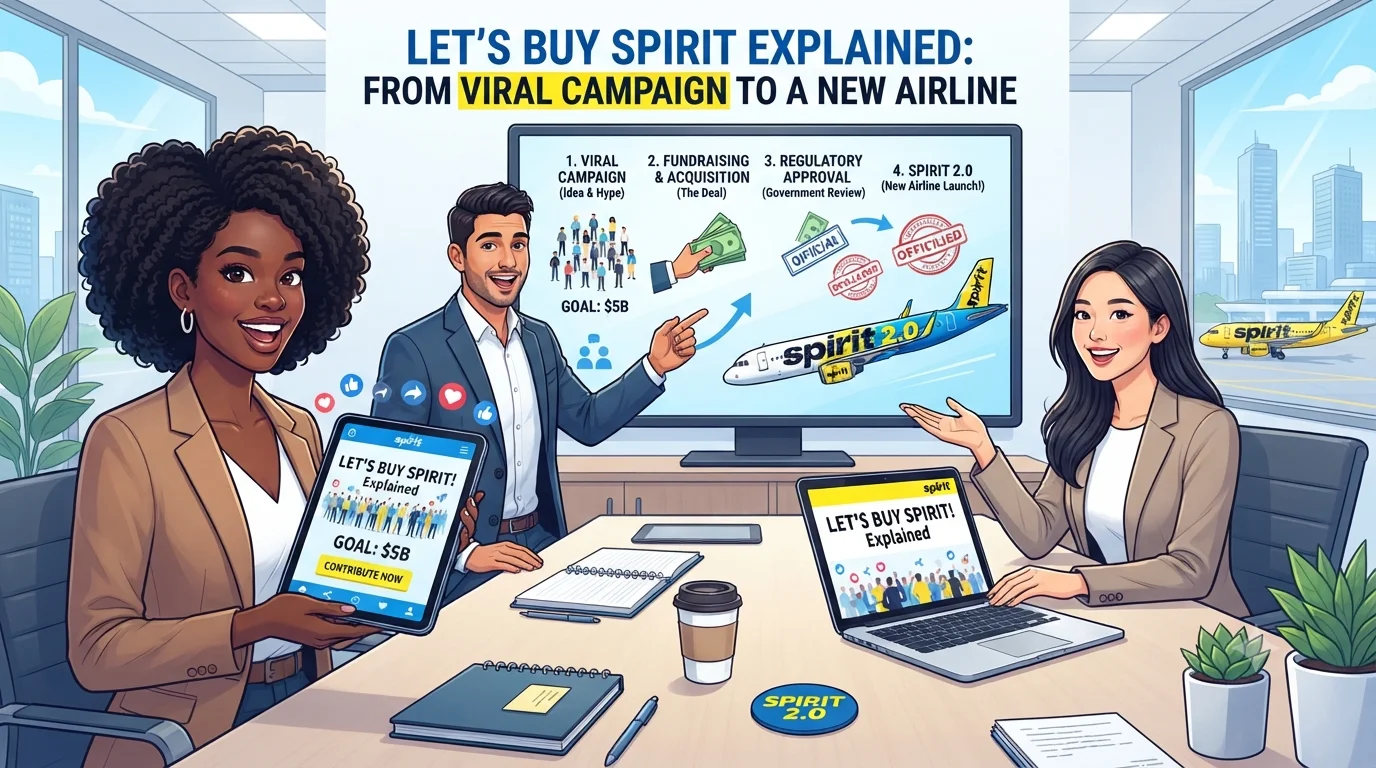
Let’s Buy Spirit was a viral community-backed campaign launched after Spirit Airlines ceased operations in May 2026. Its original idea was to gather enough public support and capital to acquire or revive Spirit through a community-oriented ownership model.
The campaign was started by content creator Hunter Peterson. His idea gained significant attention after Spirit announced its shutdown, with supporters entering non-binding pledges toward a proposed acquisition.
However, the original acquisition plan did not result in the purchase of Spirit Airlines.
By June 2026, Peterson’s group said it had decided not to continue pursuing the Spirit purchase. The project subsequently shifted toward creating a new airline from the ground up.
Let’s Buy Spirit at a Glance
| Factor | Details |
|---|---|
| Campaign | Let’s Buy Spirit |
| Origin | Viral social-media campaign following Spirit’s shutdown |
| Founder/creator | Hunter Peterson |
| Original goal | Explore a community-backed purchase or revival of Spirit |
| Spirit shutdown | May 2, 2026 |
| Early reported pledges | About $22.8 million from 36,000+ participants |
| Later reported pledges | More than $214 million from 247,000+ participants |
| Were pledges the same as collected funds? | No |
| Did the campaign buy Spirit? | No |
| Later direction | Build a new airline |
| Current project associated with | First Jet Air |
| New concept | A new airline built around a people/member-oriented model |
Reported pledge totals changed quickly during the campaign, so historical figures should be treated as campaign-reported pledges rather than verified cash raised.
What Is Let’s Buy Spirit?
Let’s Buy Spirit was originally a social-media-driven idea to collectively acquire or revive Spirit Airlines after the carrier shut down.
The campaign emerged almost immediately after Spirit’s May 2, 2026 announcement that it had begun an orderly wind-down of operations.
Peterson’s pitch was straightforward: instead of allowing Spirit’s assets to disappear into conventional liquidation or acquisition processes, could a large community of travelers pool enough support to create a people-oriented airline?
The proposal drew inspiration from community ownership models, including the public ownership structure associated with the Green Bay Packers. The campaign envisioned passengers and supporters becoming part of a broader ownership community rather than simply customers.
That original idea was ambitious.
Buying an airline is fundamentally different from launching a crowdfunding campaign. An acquisition can involve aircraft, airport slots, leases, intellectual property, labor arrangements, debt, regulatory approvals, operating certificates, and other assets or obligations.
Consequently, a large number displayed on a crowdfunding website did not by itself mean that an airline acquisition was financially or legally ready to happen.
Why Did Spirit Airlines Shut Down?
Understanding Let’s Buy Spirit requires understanding what happened to Spirit itself.
On May 2, 2026, Spirit Aviation Holdings announced that Spirit Airlines had begun an immediate orderly wind-down of operations. The company said all flights had been canceled and instructed passengers not to go to the airport.
Spirit said the decision followed extensive restructuring efforts and attempts to strengthen its financial position.
The company specifically cited a material increase in oil prices and other pressures that had significantly affected its financial outlook. Spirit also said that no additional funding was available.
Spirit had already been operating under significant financial pressure and had filed for Chapter 11 bankruptcy protection in 2025. The May 2026 wind-down therefore came after an extended period of financial difficulty rather than as an isolated event.
Once Spirit stopped flying, the airline’s aircraft, leases, airport-related assets, brand-related interests, and other holdings became part of a complicated restructuring and liquidation process.
That situation created the backdrop for the Let’s Buy Spirit idea.
Who Started Let’s Buy Spirit?
The campaign was launched by Hunter Peterson, a digital creator and voice actor who had already produced airline-related content before the Spirit shutdown.
Peterson became particularly associated with Spirit after creating content around an unusual challenge involving continuous travel on Spirit flights. His existing interest in the airline helped provide context for the campaign that followed its closure.
After Spirit announced its shutdown, Peterson published a video proposing that ordinary people could collectively attempt to buy the airline.
The idea quickly moved beyond a social-media joke.
A website was created to collect expressions of interest, and users began entering proposed contribution amounts.
The resulting campaign attracted attention from travelers, aviation enthusiasts, former Spirit supporters, and people interested in alternative ownership structures.
How Did the Campaign Become Viral?
The timing played a major role.
Spirit had just announced that it was ending operations. Many travelers were searching for information about the airline, while social media was filled with reactions to the shutdown.
Peterson’s proposal offered a simple question:
What if the people who actually used Spirit tried to bring it back?
The concept was easy to understand and highly shareable.
Within a short period, the campaign website attracted so much traffic that it experienced technical problems. Yahoo News reported that the original campaign had received more than 36,000 pledges totaling approximately $22.8 million by May 3.
Later reporting showed the numbers increasing dramatically.
The Economic Times reported on May 7 that the campaign had recorded more than 247,000 pledges totaling over $214 million.
These numbers helped turn a viral internet idea into a widely discussed aviation story.
How Much Money Was Pledged?
The answer depends on when the campaign was measured.
Early reporting showed approximately:
- 36,000+ participants
- $22.8 million in reported pledges
Later figures cited:
- 247,000+ participants
- More than $214 million in reported pledges
The distinction between pledged and raised is extremely important.
A pledge can represent someone’s stated willingness to contribute under certain circumstances. It does not necessarily mean the person transferred money to the campaign.
The campaign itself described the original commitments as non-binding. Therefore, it would be inaccurate to say that Let’s Buy Spirit simply “raised $214 million” in the conventional fundraising sense.
A more accurate description is:
The campaign reported more than $214 million in non-binding pledges at one point.
That difference matters when evaluating the project’s financial position.
Were the Pledges Real Money?
The reported pledges should not be confused with completed investment transactions.
The original campaign collected expressions of intent rather than treating the displayed total as an equivalent amount of cash sitting in a corporate bank account.
This structure allowed the organizers to measure potential public interest without presenting the pledge total as completed financing.
The distinction is especially important because acquiring and operating an airline requires substantially more than demonstrating public interest.
A serious acquisition would require legal structures, financing, due diligence, regulatory work, asset negotiations, operational planning, and other requirements.
A viral pledge campaign can demonstrate interest.
It does not automatically establish that an acquisition can close.
What Was Spirit 2.0?
As the campaign developed, supporters began referring to the proposed revival as Spirit 2.0.
The basic concept was to create a new version of Spirit that would preserve some of the characteristics supporters associated with the airline while using a different ownership structure.
The campaign discussed ideas such as:
- Community participation
- Passenger-oriented ownership
- Affordable air travel
- Worker participation
- Cooperative-style governance
- Transparent operations
These were proposed concepts rather than established features of an operating airline.
The distinction is important because Spirit 2.0 was not an existing airline flying passengers in 2026.
It was a proposed project connected to the broader Let’s Buy Spirit movement.
Did Let’s Buy Spirit Actually Buy Spirit Airlines?
No.
The Let’s Buy Spirit campaign did not acquire Spirit Airlines.
Spirit itself ceased operations on May 2, 2026, and its corporate restructuring and liquidation process continued separately.
The original community-backed acquisition concept therefore did not result in the purchase of Spirit.
By June, the organizers had decided not to continue pursuing the acquisition. TravelPulse reported that the group did not meet the amount it needed to make a bid before a relevant deadline and subsequently chose not to continue with the fundraising effort for the acquisition.
This is one of the most important facts for anyone searching for Let’s Buy Spirit today.
The campaign should not be described as if Spirit Airlines was successfully purchased by its online supporters.
Why Did the Acquisition Plan Change?
Buying an airline is a complicated transaction.
Even if a group attracts hundreds of thousands of interested supporters, it still has to address questions such as:
- Which assets are being purchased?
- What liabilities remain?
- How much capital is actually available?
- Which aircraft can be acquired or leased?
- What happens to airport slots?
- What happens to employees?
- Which operating certificates are available?
- What regulatory approvals are necessary?
- How will the new airline be financed?
- How will operations be funded before revenue becomes stable?
TravelPulse reported that the original group ultimately decided not to continue pursuing the acquisition after developments in Spirit’s bankruptcy process and changes to the fundraising approach.
By August, reporting indicated that the project had moved away from purchasing Spirit’s remaining assets and toward creating a new airline.
What Is First Jet Air?
First Jet Air is the new-airline project associated with the evolution of the original Let’s Buy Spirit movement.
Its current public description says the project began with the idea of buying Spirit but later changed direction.
The company states that in June it walked away from purchasing Spirit and decided to build an airline from the ground up. Its stated vision centers on an airline where the people who fly it can have an ownership role.
That represents a significant change in strategy.
The original question was:
Can we buy Spirit?
The newer question is:
Can we build a new airline around the people who fly it?
First Jet Air’s public materials describe the project as a privately held airline venture founded in 2026.
Is First Jet Air the Same as Spirit Airlines?
No.
This distinction should be clear.
Spirit Airlines was an established U.S. airline that ceased operations in May 2026.
Spirit 2.0 was the proposed revival/community-ownership concept associated with the Let’s Buy Spirit campaign.
First Jet Air is the newer project that emerged after the decision not to pursue the Spirit acquisition.
First Jet Air’s own description says the group moved away from buying Spirit and instead decided to build an airline from the ground up.
Therefore, readers should not assume that First Jet Air is simply Spirit Airlines under a new name.
The projects are connected historically, but they are not the same operating airline.
How Could a New Airline Work?
The emerging First Jet Air concept is centered on a member- or customer-oriented ownership model.
Its public description says the vision is for travelers to have an ownership relationship with the airline, with the company emphasizing people, safety, and profits as foundational priorities.
A future airline built around such a model could potentially explore ideas such as:
- Membership programs
- Customer ownership
- Loyalty tied to participation
- Community governance
- Lower-cost travel
- Employee participation
- Alternative revenue models
However, proposed business models should not be confused with confirmed operating features.
A new airline still needs aircraft, crews, maintenance arrangements, airport access, regulatory approvals, insurance, financing, technology systems, and an operating structure.
The concept may sound simple from a consumer perspective.
Behind the scenes, aviation remains capital-intensive and highly regulated.
Why Building an Airline Is Difficult
The Let’s Buy Spirit story also demonstrates why buying or creating an airline is much harder than raising public interest.
Aircraft
An airline needs access to aircraft through ownership, leasing, or other arrangements.
Airport Access
Routes depend on airport infrastructure, gates, slots where applicable, and agreements.
Regulatory Approval
A commercial airline needs to meet extensive safety and operational requirements.
Employees
Pilots, flight attendants, mechanics, dispatchers, customer-service workers, and other specialists are essential.
Maintenance
Aircraft require ongoing inspections, repairs, parts, maintenance programs, and qualified personnel.
Fuel
Fuel represents a major operating expense and can change significantly with market conditions.
Technology
A modern airline needs reservation systems, payment infrastructure, crew systems, flight operations technology, websites, mobile applications, customer support, and cybersecurity.
Working Capital
An airline needs substantial capital to operate even before its revenue model becomes mature.
Spirit’s own May 2026 announcement highlighted how higher oil prices and other financial pressures contributed to its decision to wind down operations.
That illustrates why airline economics can change quickly.
What Should Supporters Know About Future Investment Opportunities?
This is an important area for anyone following the project.
The original Let’s Buy Spirit campaign involved non-binding pledges. That is fundamentally different from purchasing shares in a company or making a regulated investment.
Current or future investment opportunities should therefore be evaluated based on the actual legal documents and offering structure, not simply on earlier social-media pledge totals.
Look for information such as:
- Legal entity receiving the investment
- Type of security or ownership interest
- Minimum investment
- Investor eligibility
- Use of funds
- Financial statements
- Risk disclosures
- Regulatory filings
- Terms and conditions
- Refund provisions
- Ownership rights
- Voting rights
- Potential dilution
- Liquidity restrictions
A website, social-media following, or large pledge counter does not by itself establish the financial or legal characteristics of an investment.
Anyone considering putting money into a future airline venture should read the actual offering documents and, where appropriate, obtain independent legal or financial advice.
Is Let’s Buy Spirit Still Active?
The original acquisition mission is no longer the current direction.
By June 2026, the organizers had decided not to continue pursuing the purchase of Spirit. By August, the initiative had shifted toward the “Let’s Build An Airline” concept.
First Jet Air now presents itself as the next stage of that evolution.
Its public profile describes the project as an airline being built from the ground up rather than an attempt to acquire Spirit’s remaining business.
For that reason, searches for Let’s Buy Spirit can return a mixture of old campaign pages, Spirit 2.0 discussions, and newer First Jet Air information.
Readers should check the date of any page they find.
Frequently Asked Questions About Let’s Buy Spirit
What is Let’s Buy Spirit?
Let’s Buy Spirit was a viral online campaign launched after Spirit Airlines shut down in May 2026. It proposed using community support and crowdfunding-style pledges to explore buying or reviving the airline.
Who started Let’s Buy Spirit?
The campaign was launched by digital creator and voice actor Hunter Peterson shortly after Spirit Airlines announced its shutdown.
How much money did Let’s Buy Spirit raise?
The campaign reported large amounts in pledges, not equivalent amounts of collected investment capital. Early reports cited approximately $22.8 million in pledges, while later reporting cited more than $214 million.
Did people actually buy Spirit Airlines?
No. The Let’s Buy Spirit campaign did not acquire Spirit Airlines.
What happened to Spirit Airlines?
Spirit Airlines began an orderly wind-down on May 2, 2026, canceled its flights, and ceased operations. The company cited financial pressures including higher oil prices and a lack of additional funding.
What is Spirit 2.0?
Spirit 2.0 was the name used for the proposed community-oriented revival of Spirit associated with the Let’s Buy Spirit campaign. It was a proposed project, not an operating airline.
What happened to the original Spirit 2.0 plan?
The acquisition effort was discontinued. The broader movement later shifted toward building a new airline instead of purchasing Spirit.
What is First Jet Air?
First Jet Air is the new airline project that emerged from the Let’s Buy Spirit movement. Its current public description says it intends to build an airline from the ground up around a people-oriented ownership concept.
Is First Jet Air owned by Spirit Airlines?
No. First Jet Air is presented as a separate new airline project rather than Spirit Airlines continuing under a different name.
Can I invest in First Jet Air?
Investment opportunities can change, so readers should rely on the project’s current official offering documents and legal disclosures rather than old Let’s Buy Spirit pledge information.
A historical pledge is not automatically an investment, ownership interest, or share in First Jet Air.
Is Let’s Buy Spirit a scam?
The original campaign’s non-binding pledge model should not be confused with a completed investment offering. At the same time, the popularity of the campaign created opportunities for impersonators and lookalike websites.
Anyone encountering a request for money should verify the exact organization, legal entity, payment destination, terms, and regulatory disclosures before sending funds.