How Growth Navigate Funding Helps Startups Prepare, Raise and Scale.

Introduction
Raising startup capital involves much more than creating a pitch deck and sending emails to investors. Founders need a clear fundraising strategy, credible financial projections, suitable investor targeting, organised due diligence materials and a compelling explanation of why the business deserves capital.
Growth Navigate Funding positions itself as a startup funding advisory firm that helps founders manage those parts of the fundraising process. According to its official website, the firm works with startups from pre-seed through Series C and offers services covering fundraising strategy, pitch deck development, investor access, financial modelling, growth strategy and due diligence preparation.
The company says it was founded in 2013 and operates from New York and San Francisco. It also reports having worked with more than 300 startups and having helped secure more than $450 million in capital. Those figures are company-reported rather than independently audited figures, so prospective clients should evaluate them alongside their own due diligence.
Quick Answer: What Is Growth Navigate Funding?
Growth Navigate Funding is a startup funding advisory business focused on helping founders prepare for and execute capital raises.
Its stated services include:
- Fundraising strategy and roadmaps
- Pitch deck development
- Investor relations and introductions
- Financial modelling and projections
- Growth strategy advisory
- Due diligence preparation
- Cap table and equity strategy
- Market entry and expansion advisory
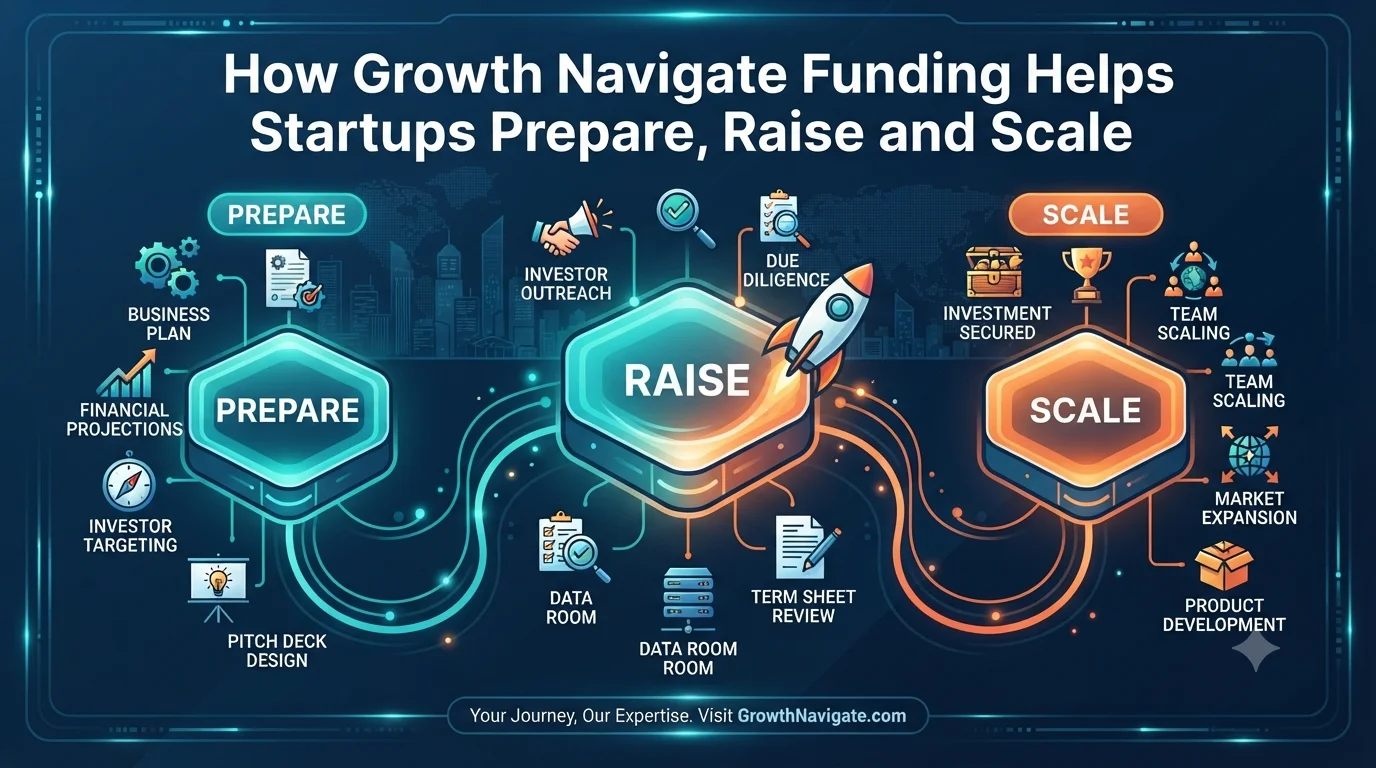
The company says its process covers four broad stages: discovery and strategy, materials and positioning, investor outreach, and closing followed by growth support.
Key Facts at a Glance
| Area | What Growth Navigate Funding Says |
|---|---|
| Business type | Startup funding and capital advisory |
| Founded | 2013 |
| Locations | New York and San Francisco |
| Startup stages | Pre-seed through Series C and beyond |
| Reported capital secured | $450M+ |
| Reported startups funded | 300+ |
| Reported investor relationships | 1,000+ |
| Reported funding success rate | 92% |
| Reported average closing time | 13 weeks |
| Main focus | Fundraising, investor access, financial preparation and growth |
Figures in this table are claims published by Growth Navigate Funding and should not be treated as independently verified performance statistics.
What Is Growth Navigate Funding?
Growth Navigate Funding presents itself as a capital advisory partner for startups rather than simply a pitch-deck design service or investor database.
Its website says the firm works with founders across funding stages, beginning with pre-seed companies and extending through Series C and later-stage raises. The stated objective is to combine fundraising strategy, investor positioning, financial preparation and access to potential capital sources.
The company says its founders previously spent more than a decade working inside venture-backed businesses and investment firms before launching the advisory practice in 2013. It also says its investor network includes venture capital firms, angel investors, family offices and strategic investors.
That positioning matters because fundraising problems rarely come from one issue alone.
A startup may have a strong product but weak investor messaging. Another business might have an attractive market but unrealistic financial projections. A founder may have a good pitch but lack relationships with investors who actually invest in that sector and stage.
A funding advisor attempts to connect these pieces into one fundraising strategy.
What Services Does Growth Navigate Funding Offer?
Growth Navigate Funding’s services are designed around different parts of the capital-raising process. The company currently lists several major advisory areas on its services page.
1. Fundraising Strategy and Roadmap
The first step in a capital raise is deciding what you are raising, why you are raising it and who should receive the pitch.
Growth Navigate Funding says its strategy service can include:
- Funding roadmaps
- Valuation benchmarking
- Funding-range analysis
- Investor persona mapping
- Investment thesis development
- Fundraising timelines
- Competitive positioning
- Market framing
This type of preparation can help a founder avoid approaching investors without a clear fundraising narrative.
For example, a pre-seed company may need to emphasise the founding team, market opportunity and early validation. A Series B company generally needs a different investor story built around growth, economics, market position and scalability.
The important point is that fundraising strategy should reflect the company’s actual stage rather than relying on one generic pitch.
2. Pitch Deck Development
A pitch deck is one of the most visible parts of a startup’s fundraising process.
Growth Navigate Funding says it develops investor-oriented decks covering areas such as:
- Market opportunity
- Competitive landscape
- Financial information
- Team and traction
- Use of funds
- Data visualisation
- Investor narrative
The company describes its standard deck architecture as 12–15 slides and reports a 91% average deck open rate. That statistic is a company-reported figure, so founders should ask how it is calculated and what sample it represents before using it as a performance benchmark.
A strong pitch deck should do more than look professional. It should answer the questions an investor is likely to have about the market, business model, traction, competitive advantage, financial outlook and funding requirement.
3. Investor Relations and Network Access
Investor discovery is another major part of the service.
According to Growth Navigate Funding, its network includes more than 1,000 active investors across categories such as VCs, angels, family offices and strategic investors. The service also includes targeted investor lists, introductions, outreach management, meeting preparation and follow-up support.
The practical value of a network depends on relevance, not simply size.
A list containing hundreds of investors is not automatically useful. The better question is whether those investors match the startup’s:
- Industry
- Geographic market
- Funding stage
- Raise size
- Business model
- Investment thesis
- Growth profile
For that reason, founders should ask how investors are selected and whether introductions are genuinely appropriate for their particular fundraising objectives.
4. Financial Modelling and Projections
Financial preparation becomes increasingly important as a startup progresses through fundraising.
Growth Navigate Funding says its financial modelling service includes:
- Three-statement financial models
- Revenue forecasts
- Unit economics
- Cohort analysis
- Scenario modelling
- Sensitivity analysis
- Cap table management
- Dilution modelling
The company says it has built more than 300 models for funded startups.
For founders, the value of financial modelling goes beyond producing attractive numbers.
Investors may want to understand how revenue is expected to develop, what drives expenses, how much additional capital may be required, what assumptions underpin growth and how ownership changes after new investment.
A model should therefore be internally consistent and explainable. If a founder cannot defend the assumptions behind the model, a polished spreadsheet will not solve the underlying problem.
5. Growth Strategy Advisory
Fundraising does not end when the money reaches the company’s bank account.
Growth Navigate Funding also offers post-funding strategy support. Its services page describes areas such as go-to-market planning, revenue optimisation, customer acquisition, product-market fit, OKRs, board reporting and preparation for future funding rounds.
This is an important distinction.
A startup can successfully raise capital and still struggle to turn that capital into sustainable growth. Hiring too quickly, expanding into unsuitable markets or spending without measurable priorities can shorten runway without creating equivalent value.
The company reports an average 4.2× revenue growth post-funding among the startups represented in its service materials. Again, this is a company-published performance claim and should be evaluated carefully rather than treated as a guaranteed outcome.
How Does the Growth Navigate Funding Process Work?
The company describes its fundraising methodology in four main stages.
Step 1: Discovery and Strategy
The process starts by understanding the startup, its market, funding objectives and current position.
The resulting strategy is intended to define the fundraising approach before investor outreach begins.
Step 2: Materials and Positioning
Next comes preparation of materials such as the pitch deck, financial model and investor narrative.
This stage is particularly important because inconsistent messaging can create unnecessary questions during investor conversations.
Step 3: Investor Outreach
Once the fundraising materials are prepared, the company says it uses its investor network to identify and approach relevant prospects.
The goal is not simply to maximise the number of investor conversations. Ideally, outreach should focus on investors whose interests match the business.
Step 4: Close and Scale
The final stage covers the move from investor interest toward closing. Growth Navigate Funding says its support can continue into term-sheet review, deal closing and post-funding growth.
The company’s contact page states that many clients close within approximately 10–16 weeks, depending on factors such as funding stage, raise size and market conditions.
That should be viewed as an indicative company-reported range rather than a promised fundraising timeline.
Who Is Growth Navigate Funding For?
The service appears most relevant to founders who need structured fundraising support rather than a standalone service.
Potential users include:
Pre-Seed Founders
Early-stage companies may need help turning an idea, prototype or early validation into an investor narrative.
At this stage, investors may pay close attention to the founding team, problem, market opportunity, product vision and evidence of demand.
Seed-Stage Startups
Seed companies may have early customers, revenue or product-market signals but need capital to accelerate growth.
Financial modelling, investor targeting and a clear use-of-funds story can become increasingly important.
Series A and Beyond
Later-stage businesses may require more sophisticated financial analysis, competitive positioning, investor outreach and due diligence preparation.
Growth Navigate Funding says it works through Series C and beyond, although the exact requirements will naturally vary by company.
Pre-Revenue Startups
The company explicitly says it works with early-stage and pre-revenue businesses. Its contact page says that, for these companies, it focuses heavily on narrative strength, team credentials and market opportunity framing.
Why Fundraising Preparation Matters
Many founders think the fundraising process starts when they contact investors.
In practice, preparation happens much earlier.
Before investor outreach begins, a founder should be able to answer questions such as:
- How much capital are we raising?
- Why do we need this amount?
- How long will it provide runway?
- What milestones will the funding achieve?
- Which investors are most relevant?
- What evidence supports our market opportunity?
- What makes the company different?
- What assumptions drive our financial forecast?
- How will the new capital affect ownership?
- What happens if growth is slower than expected?
A funding advisor can help organise these questions into a coherent fundraising strategy.
However, founders should still understand their own numbers and decisions. Advisory support should improve the company’s preparedness rather than replace founder responsibility.
Growth Navigate Funding Pricing
Growth Navigate Funding currently publishes several advisory packages on its services page.
| Package | Published Price | Selected Services |
|---|---|---|
| Launchpad | $4,500/month | Strategy session, deck review, investor list, model health check and ongoing support |
| Navigator | $9,500/month | Full pitch deck, three-statement model, targeted investor list, introductions and advisory calls |
| Ascent | Custom | Full-service fundraising, senior advisor support, investor introductions, due diligence and term-sheet support |
The company also states that Ascent pricing is customised. Its contact page says the primary model is a monthly advisory retainer, while a small success fee may apply to full-service Ascent engagements.
Prices can change, so founders should confirm current fees, inclusions, contract length and any additional charges directly before entering an engagement.
What Should Founders Check Before Hiring a Funding Advisor?
Hiring a fundraising advisor is a significant business decision. A founder should evaluate the advisor in much the same way they would evaluate an investor.
Check the Actual Deliverables
Do not rely only on broad descriptions such as “fundraising support.”
Ask exactly what will be delivered, how often meetings occur, who will work on the account and what happens between meetings.
Understand Investor Introductions
Ask whether introductions are warm or cold, how investors are selected and how many introductions are realistically expected.
Review Financial Responsibilities
Clarify whether the advisor builds the model, reviews an existing model or simply provides guidance.
Ask About Fundraising Strategy
A good strategy should reflect the company’s stage, market, raise size and investor profile.
Understand the Fee Structure
Monthly retainers, success fees and additional expenses should be clearly documented before work begins.
Request Evidence
Company-reported statistics can provide useful context, but founders should ask what those figures mean and whether relevant case studies can be shared.
Is Growth Navigate Funding Worth Considering?
Growth Navigate Funding may be worth considering for founders who want structured support across multiple stages of the fundraising process.
Its stated offering goes beyond pitch-deck preparation. The company combines fundraising strategy, investor targeting, financial modelling, due diligence and post-funding advisory services.
The biggest potential advantage is therefore the breadth of the service.
At the same time, advisory support is not a substitute for a strong business. No consultant can guarantee investor interest, funding approval, valuation or successful execution.
Founders should assess the firm’s services against their actual needs, budget, funding stage and investor strategy before signing an engagement.
Final Takeaway
Growth Navigate Funding is positioned as a full-service startup funding advisory firm rather than a simple investor database or pitch-deck agency.
Its offering covers much of the fundraising journey, including strategy, investor positioning, pitch decks, financial modelling, investor introductions, due diligence and post-funding growth support. The company says it has worked with more than 300 startups and secured more than $450 million in capital, although these figures should be understood as company-reported claims.
For founders considering an advisor, the most important question is not simply whether Growth Navigate Funding has an extensive service list. The better question is whether its approach, investor network, pricing and expertise match the startup’s particular fundraising situation.
A strong advisory relationship should ultimately make the fundraising process more organised, more targeted and easier for investors to understand while keeping the founder in control of the business and its financial decisions.
What does Growth Navigate Funding do?
Growth Navigate Funding provides startup funding advisory services covering fundraising strategy, pitch decks, investor access, financial modelling, due diligence and growth strategy.
What startup stages does Growth Navigate Funding support?
The company says it supports startups from pre-seed through Series C and beyond.
How much does Growth Navigate Funding cost?
Its published packages currently include Launchpad at $4,500 per month and Navigator at $9,500 per month, while Ascent uses custom pricing.
Does Growth Navigate Funding provide investor introductions?
Yes. The company says its investor relations service includes targeted investor lists and warm introductions through its network.
Does Growth Navigate Funding work with pre-revenue startups?
According to its contact page, yes. The company says it works with startups from pre-seed concept validation through Series C and places additional emphasis on team credentials, narrative and market opportunity for early-stage businesses.