
WebPayBlog.com Review 2026: Is It Safe, Legit, and Worth Trusting?

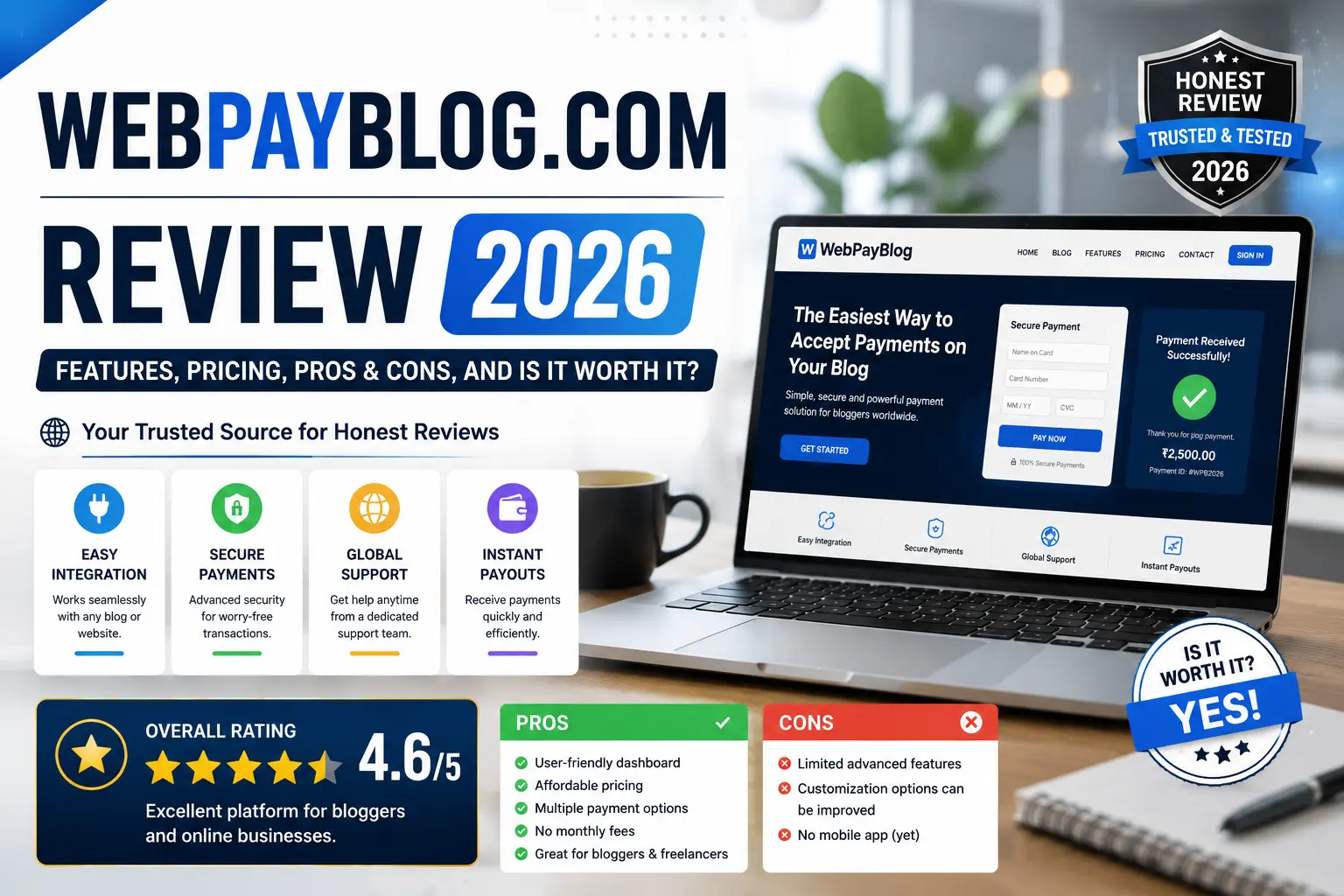
WebPayBlog.com is a broad informational website covering subjects such as finance, healthcare, technology, travel, automotive topics, lifestyle, business, and other online resources. Although the domain name contains the word “Pay,” the website does not appear to operate as a bank, payment gateway, digital wallet, merchant processor, or transaction platform.
Instead, its visible structure is that of a general-purpose blog. That distinction matters. Readers should evaluate individual articles based on their sources, publication dates, authorship, and subject matter rather than assuming everything published on the domain carries the same level of authority.
This becomes particularly important when an article discusses banking, money, healthcare, account access, cybersecurity, downloads, or personal information.
[VERIFY] The website’s current activity, ownership information, and individual article details should be checked directly before treating them as current facts.
Quick Answer
| Question | Short answer |
|---|---|
| Is WebPayBlog.com active? | It displays published content, but current activity should be independently checked. |
| Is it a payment processor? | No visible payment-processing service is apparent. |
| Is it a general blog? | Yes, its structure and content indicate an informational publication. |
| Is every article reliable? | No. Important claims should be verified independently. |
| Should you enter financial credentials there? | Only use the independently verified official website or app of the relevant institution. |
What Is WebPayBlog.com?
WebPayBlog.com appears to be structured like a conventional WordPress-style informational publication, rather than a financial technology platform.
Visitors can find the types of elements normally associated with a content website, including:
- Category pages
- Individual articles
- Article archives
- Published dates
- Author information
- Internal navigation
- Search functionality
- Older and newer posts
Its publishing topics are broad. Finance and banking appear alongside healthcare, technology, travel, automotive information, lifestyle, business, and general-interest subjects.
Some articles have been published under the author name Dipti. [VERIFY] An author byline alone should not be interpreted as proof that the writer has professional expertise in every category covered by the website. This is particularly relevant when content deals with medical, financial, legal, or security-related subjects.
What WebPayBlog.com Does Not Appear to Offer
Despite its name, the website does not visibly present itself as a conventional payment company.
There is no obvious indication that its primary service is:
- Merchant account creation
- Card payment processing
- Payment API access
- Checkout infrastructure
- Digital wallet services
- Transaction dashboards
- Settlement management
- Refund processing
- Merchant onboarding
- Consumer banking accounts
That difference is easy to miss when someone first sees the domain name.
The word “Blog” is a better description of the site’s visible function than “Pay.”
Why Are People Searching for WebPayBlog.com?
A search for “WebPayBlog com” can come from several different situations. In many cases, the person is not trying to find a financial service at all. They simply want to understand an unfamiliar domain they have encountered somewhere online.
They Found the Domain in Search Results
A person might come across WebPayBlog.com through:
- Google Search
- Social media
- A guest-post marketplace
- A backlink report
- A shared article
- Another website
- An external link
- A redirect
Once someone sees a domain they do not recognize, the natural question is straightforward:
Is this a genuine website, and is it safe to trust?
That is a reasonable question, particularly when the domain name sounds as though it could be connected with financial services.
The Word “Pay” Raises Safety Questions
The domain may cause visitors to think about:
- Credit-card information
- Banking credentials
- Fraud
- Phishing
- Password theft
- Suspicious downloads
- Personal-data collection
Those concerns do not, by themselves, prove that a website is malicious. They explain why visitors may want to investigate the domain before clicking links or sharing information.
Visitors May Be Looking for the Business Behind It
Some users may want to determine:
- Who owns the website
- Where the publisher is based
- Who operates the publication
- How to contact the organization
- Who writes the articles
- Whether the website is connected to a bank
- Whether it belongs to a payment company
If ownership and editorial information are not clearly presented, confidence can naturally be lower.
SEO Professionals May Be Researching the Domain
There is also a commercial search intent around websites such as this.
Bloggers, advertisers, SEO professionals, agencies, and link builders may investigate WebPayBlog.com for:
- Guest posts
- Sponsored articles
- Backlink opportunities
- Brand mentions
- Organic visibility
- Topical relevance
- Referral traffic
- Publishing opportunities
For these users, simply proving that the domain exists is not enough. They also need to determine whether the site has genuine audience value and editorial credibility.
Is WebPayBlog.com a Payment Gateway?
WebPayBlog.com does not visibly present itself as a payment gateway. Its visible purpose appears to be publishing informational articles rather than processing customer transactions.
A conventional payment gateway generally offers several features associated with accepting and managing payments, such as:
- Merchant registration
- Supported payment methods
- Transaction pricing
- Checkout functionality
- Developer documentation
- API access
- Fraud controls
- Refund processes
- Chargeback management
- Security documentation
- Merchant support
WebPayBlog.com instead presents the familiar elements of a content publication: articles, categories, author pages, navigation, and archived posts.
| Feature | Informational blog | Payment gateway | WebPayBlog.com appears to provide |
| Publishes articles | Yes | Sometimes | Yes |
| Processes customer transactions | No | Yes | Not visibly |
| Payment APIs | No | Commonly | Not visibly |
| Merchant accounts | No | Commonly | Not visibly |
| Banking credentials required to read | No | No | Should not be required |
| Financial information | Sometimes | Sometimes | Yes, among broader topics |
Why This Difference Matters
Mistaking a content website for a financial service can create unnecessary risks.
For example, a visitor might:
- Search for customer support that the site does not provide
- Treat a third-party article as official bank instructions
- Assume a banking relationship exists when it does not
- Follow an external link without checking the destination
- Use outdated instructions to access an account
- Provide sensitive information to the wrong website
The safer assumption is simple: treat WebPayBlog.com as a third-party information source, not as a financial institution.
What Topics Does WebPayBlog.com Cover?
One of the defining characteristics of WebPayBlog.com is its broad editorial scope. It is not limited to a single specialist subject.
That variety can make the website useful for general information, but it also raises an important question: does one publication have the same level of expertise across finance, health, technology, automobiles, and travel?
Usually, readers should not assume that it does.
Finance and Banking
The website has published content relating to financial services, banking, credit cards, business funding, and account-related subjects. Names associated with finance-related articles have included Cosmos Bank and Bank of Baroda. [VERIFY]
Financial content can be useful when someone wants to understand a term, identify a service, or find questions worth researching.
The problem is that financial information can change quickly.
Readers should independently confirm:
- Bank login URLs
- Application procedures
- Interest rates
- Fees and charges
- Customer-service numbers
- Eligibility requirements
- Credit-card terms
- Security instructions
- Account-access procedures
When taking an actual banking action, use the bank’s verified official website or official mobile application.
Health and Patient Portals
WebPayBlog.com has also covered healthcare-related platforms and services, including subjects associated with MyBassett Health and MyOptumHealth. [VERIFY]
Health information deserves a higher level of scrutiny because inaccurate instructions can affect real decisions.
Potentially sensitive areas include:
- Medical decisions
- Patient privacy
- Medication information
- Appointment management
- Health-account access
- Insurance details
- Portal credentials
An article explaining how a healthcare portal works may be useful as an introduction. However, before entering medical credentials, verify the portal address directly with the healthcare organization.
General online health content should not be treated as a substitute for advice from a qualified healthcare professional.
Technology and Digital Services
Technology-related articles can cover subjects such as:
- Websites
- Software
- Streaming platforms
- Online tools
- Login procedures
- Mobile applications
- Troubleshooting
- Digital entertainment
Technology advice can be harmless, but certain instructions create security risks.
Pay particular attention when an article asks you to:
- Download an unknown file
- Install an extension
- Install an application
- Disable security software
- Visit a suspicious login page
- Use an unofficial download source
- Grant unnecessary permissions
Potential warning signs include malware, fake login pages, misleading buttons, redirects, outdated instructions, and excessive permission requests.
Automotive Content
Automotive coverage may include vehicle features, comparisons, maintenance information, and general vehicle-related topics. The Acura ILX has appeared as an example of the automotive subjects associated with the publication. [VERIFY]
Such articles can be useful for initial research, but specifications and safety-related information should be checked against primary sources, including:
- Vehicle manufacturers
- Authorized dealers
- Owner’s manuals
- Government safety resources
- Qualified automotive professionals
Travel, Lifestyle, and General Topics
The website also covers lifestyle and travel-related subjects, including destinations such as Provence. [VERIFY]
These subjects generally carry less immediate risk than medical or banking information, but they still change over time.
Before making a decision based on travel information, confirm:
- Prices
- Opening times
- Local regulations
- Visa or travel-document requirements
- Transportation availability
- Seasonal conditions
- Accommodation information
| Category | General risk | Main things to verify |
| Lifestyle | Low | Accuracy and usefulness |
| Travel | Medium | Dates, prices, rules, availability |
| Automotive | Medium | Specifications and safety information |
| Technology | Medium–high | Downloads, privacy, security |
| Finance | High | Official procedures and credentials |
| Health | High | Medical accuracy and professional review |
Is WebPayBlog.com Legitimate?
WebPayBlog.com appears to operate as a publishing website, based on its visible articles, navigation, categories, archives, and author information.
But “legitimate” is a broader question than simply asking whether a website is online.
A site can be genuine and still publish outdated or poorly researched information.
Signs That It Functions as an Active Publication
Visible signals can include:
- An accessible domain
- Published articles
- Category structures
- Internal links
- Article dates
- Author names
- Archived content
These characteristics suggest a functioning content website rather than a completely empty or parked domain.
[VERIFY] Current publication activity should be checked directly because website content and availability can change.
Ownership and Editorial Information May Need More Investigation
A stronger trust assessment should look for transparent information about:
- Legal ownership
- Publishing company
- Business location
- Editorial team
- Writer qualifications
- Review processes
- Sponsorship policies
- Corrections
- Funding
- Contact information
If these details are difficult to establish, readers should be more cautious about treating the site as an authoritative source.
A Real Website Is Not Automatically an Expert Website
These are different questions:
Is the website real?
Is the website accurate?
Is the author qualified?
Has the information been reviewed?
Is the content current?
A site can be active but outdated, secure but inaccurate, useful for beginners but unsuitable for high-stakes decisions, or legitimate without having specialist editorial oversight.
That is why a simple “safe” or “scam” label often does not tell the whole story.
A Practical Evidence Scale
When evaluating a claim about WebPayBlog.com, consider the strength of the available evidence.
Confirmed
The information is directly visible on the website or supported by a reliable primary source.
Reasonably Inferred
The conclusion is supported by the site’s structure, content, or other observable signals but is not explicitly stated.
Unverified
The information is not clearly disclosed and cannot be confidently confirmed.
Unsupported
A claim is made without reliable evidence.
This method gives readers a much more useful assessment than simply calling an unfamiliar website “good” or “bad.”
Is WebPayBlog.com Safe to Visit?
Visiting a public article is not the same thing as entering credentials, downloading software, making a payment, or following an account-access instruction.
WebPayBlog.com may be suitable for ordinary browsing, but no third-party review should provide an unconditional guarantee that every page, external link, or future article will be safe.
Check Basic Technical Signals
Before interacting with an unfamiliar site, look at:
- Whether HTTPS is enabled
- Whether the spelling of the domain is correct
- Whether unexpected redirects occur
- Whether the browser displays a security warning
- Whether downloads start automatically
- Whether pop-ups make alarming claims
- Whether the site requests unusual permissions
- Whether a login form appears on an unrelated domain
HTTPS is useful for protecting the connection, but HTTPS alone does not prove that the information on a website is accurate or trustworthy.
Never Share Sensitive Information Casually
A blog article should not be a reason to provide:
- Bank passwords
- Card PINs
- Social Security numbers
- One-time authentication codes
- Cryptocurrency recovery phrases
- Medical portal passwords
- Government identification numbers
- Complete payment-card details
If an article explains how to access a service, use that information only as a starting point. Perform the final login or transaction through the independently verified official organization.
Leave When Something Looks Wrong
Stop interacting with a page if:
- A normal article suddenly asks for payment details
- A bank link points to an unfamiliar domain
- A file downloads without permission
- A pop-up claims that your device is infected
- Your browser reports a certificate problem
- A login page looks different from the institution’s official site
- Someone asks for a one-time verification code
These are not situations where you should “try it and see.”
A Safer Browsing Process
When following information from an unfamiliar blog, use this simple sequence:
- Check the exact domain.
- Look at where external links actually lead.
- Search for the organization independently.
- Compare the information with an official source.
- Use official applications for banking and healthcare services.
- Do not download software unless the source is verified.
- Stop if the website behaves differently from what you expected.
This approach takes a little longer but dramatically reduces the chance of confusing third-party information with an official service.
Can You Trust Information Published on WebPayBlog.com?
There is no single answer for every article.
The reliability of a particular page depends on who wrote it, when it was published, what evidence it uses, whether it has been updated, and how serious the consequences would be if the information were wrong.
Check the Author
Look for:
- Full name
- Biography
- Relevant qualifications
- First-hand experience
- Other published work
- Author profile
- Contact information
Good writing does not automatically mean professional expertise.
Someone may explain banking terminology clearly without being a financial professional. The same applies to healthcare, technology security, legal matters, and other specialist fields.
Check the Publication and Update Date
Dates are especially important for time-sensitive subjects.
Older content may contain outdated:
- Banking login instructions
- Credit-card fees
- Software procedures
- Travel requirements
- Website addresses
- Healthcare portal instructions
- Vehicle specifications
A publication date tells you when something was first posted. A clearly displayed last-updated date can provide better context when procedures or facts have changed.
Examine the Sources
Higher-quality informational content commonly points readers toward primary or authoritative sources, such as:
- Official company websites
- Banks
- Government agencies
- Medical organizations
- Vehicle manufacturers
- Original technical documentation
- Established research
Be more cautious when an article depends heavily on:
- Anonymous sources
- Other low-quality blogs
- Unsupported statistics
- Broken references
- Circular citations
- Vague statements such as “many people say”
Look for Editorial Transparency
Useful trust signals include:
- Editorial guidelines
- Fact-checking policies
- Correction policies
- Specialist review
- Revision history
- Sponsorship disclosures
When these signals are missing, the reader has to do more of the verification themselves.
Use the Website According to the Risk Level
WebPayBlog.com may be useful for:
- General reading
- Exploring an unfamiliar topic
- Learning basic terminology
- Discovering questions to research
- Getting an overview of a service
- Finding ideas for further research
It should not be the sole source for:
- Financial transactions
- Medical treatment decisions
- Legal decisions
- Account recovery
- Sensitive downloads
- Sharing confidential information
The higher the potential consequence, the more important primary-source verification becomes.
WebPayBlog.com vs Similar-Sounding Domains
One of the biggest sources of potential confusion is the similarity between domain names.
A familiar-looking name does not establish ownership, partnership, or affiliation.
WebPayBlog.com vs WebPayBlog.org
WebPayBlog.com and WebPayBlog.org are separate domains.
They should not automatically be assumed to:
- Have the same owner
- Share an editorial team
- Belong to the same company
- Follow the same publishing standards
- Have a business relationship
Treat the domains separately unless reliable documentation demonstrates a connection.
WebPayBlog.com vs Webpay.com
Webpay.com may be associated with payment-related services, while WebPayBlog.com appears to function as an informational publication.
The distinction is the purpose of the service:
Payment company: provides financial or transaction-related services.
Blog: publishes informational content.
A similar name does not prove that the two websites are connected.
WebPayBlog.com vs Webpay.net
Webpay.net is another similarly named domain that may be associated with payment-related services. [VERIFY]
Again, the precise domain matters.
| Domain | Apparent purpose | Article publishing | Payment processing |
| WebPayBlog.com | Multi-topic informational publication | Yes | Not visibly |
| WebPayBlog.org | Separate informational website | Yes | Not established |
| Webpay.com | Payment-related business | Possibly | May provide payment services |
| Webpay.net | Payment-related service | Possibly | May provide payment services |
Before entering financial information, independently locate the organization you intend to use and confirm its official domain through trusted documentation.
Is WebPayBlog.com Useful for Readers in the United States?
U.S. visitors can access WebPayBlog.com, but that does not mean every article is specifically written for an American audience.
Some finance-related content has referenced institutions such as Cosmos Bank and Bank of Baroda, which indicates that certain material may relate to markets outside the United States. [VERIFY]
For U.S. readers, regional context matters.
Questions American Readers Should Ask
Before acting on an article, ask:
- Is this service actually available in the United States?
- Does the information reflect U.S. regulations?
- Are prices presented in U.S. dollars?
- Does the institution serve American customers?
- Is the financial provider regulated appropriately?
- Does the healthcare information apply to my provider?
- Are the privacy requirements relevant to my state?
- Is the article discussing an international process?
A process that is correct in one country can be completely different somewhere else.
Verifying Financial Information in the United States
For financial matters, use primary sources such as:
- Official bank websites
- Verified banking applications
- Government regulators
- Official customer-service numbers
- Card-issuer documentation
- Consumer-protection resources
Verifying Health Information in the United States
For healthcare information, consider checking with:
- Licensed healthcare professionals
- Official hospital portals
- Government health agencies
- Recognized medical institutions
- Professional medical organizations
International health information may not reflect your insurance plan, provider, state requirements, or healthcare system.
The V.E.R.I.F.Y. Framework for WebPayBlog.com
A practical way to evaluate an unfamiliar article is to use the V.E.R.I.F.Y. framework.
V — Verify the Exact Domain
Check:
- Domain spelling
- Domain extension
- HTTPS
- Redirect destination
- Whether the domain matches the organization you intended to visit
A single character can make the difference between the legitimate destination and a deceptive copy.
E — Establish the Page’s Purpose
Identify what kind of page you are viewing:
- Informational article
- Advertisement
- Sponsored content
- Transaction page
- Login page
- Download page
A normal blog article should not unexpectedly turn into a banking or account-login form.
R — Review the Author and Publisher
Check:
- Author credentials
- Publisher identity
- Contact information
- Editorial policies
- Sponsorship disclosures
- Relevant professional experience
The more sensitive the subject, the more important this step becomes.
I — Inspect Dates, Sources, and Links
Ask:
- When was the article published?
- When was it last updated?
- Does it cite an official source?
- Do external links reach legitimate domains?
- Are any links broken?
- Do redirects lead somewhere unexpected?
F — Fact-Check High-Impact Claims
Give additional attention to information affecting:
- Money
- Health
- Privacy
- Personal safety
- Legal rights
- Account access
- Device security
Do not rely on one general blog when a mistake could cost money, compromise an account, or affect your health.
Y — Yield to the Official Source
For the final action, go directly to the verified:
- Bank
- Healthcare provider
- Government organization
- Manufacturer
- Software developer
- Payment company
A third-party blog can explain a process. The organization responsible for that process should remain the final authority.
LEARN MORE: Obsails.com
[VERIFY] Any external website mentioned in connection with WebPayBlog.com should be independently checked before users follow links or rely on its information.
Strengths and Limitations of WebPayBlog.com
A fair review should look at both sides.
Potential Strengths
The website may be useful because it provides:
- A wide variety of topics
- Simple article formatting
- Beginner-oriented explanations
- Category navigation
- General topic discovery
- Publicly accessible articles
- A starting point for additional research
Potential Limitations
Readers should also consider:
- A very broad topical focus
- Uneven specialist expertise
- Limited visible publisher information
- Inconsistent evidence of author qualifications
- Potentially outdated information
- Unclear editorial review standards
- Limited primary-source references on some pages
- Confusion caused by the domain name
- Insufficient authority for high-stakes decisions
| Useful for | Not ideal as the final source for |
| General topic discovery | Major financial decisions |
| Basic explanations | Medical diagnosis or treatment |
| Learning terminology | Banking credentials |
| Casual research | Official customer support |
| Initial investigation | Security-sensitive downloads |
Should You Buy a Guest Post or Backlink From WebPayBlog.com?
SEO professionals may encounter WebPayBlog.com while looking for guest-post, sponsored-content, or backlink opportunities.
If that happens, do not judge the domain only by Domain Authority (DA), Domain Rating (DR), or another third-party metric.
A high metric does not automatically mean that a website has an engaged audience, strong editorial standards, or useful referral traffic.
Metrics That Do Not Prove Quality on Their Own
Avoid making a publishing decision solely because of:
- DA
- DR
- Estimated monthly traffic
- Number of indexed pages
- A low placement price
- Ranking guarantees
- A seller’s promises
These metrics can be useful as part of an SEO audit, but they are not enough on their own.
Backlink Due-Diligence Checklist
Before paying for a guest post or link, examine:
- Current organic traffic
- Traffic trends
- Ranking keywords
- U.S. traffic percentage
- Topical relevance
- Article quality
- Number and type of outbound links
- Anchor-text patterns
- Sponsored-content disclosures
- Indexation stability
- Domain history
- Page-level traffic
- Referral potential
- Actual link placement
When a Guest Post May Make Sense
A placement could be reasonable when:
- Your subject matches the website’s existing content
- The article genuinely helps readers
- The backlink is contextually relevant
- The target page is useful to the audience
- Sponsored content is disclosed appropriately
- Organic visibility can be independently confirmed
The objective should be genuine visibility and relevance rather than manipulating authority metrics.
When You Should Reconsider
Be cautious when:
- Traffic cannot be independently verified
- The website publishes unrelated commercial topics in large volumes
- Articles contain excessive paid links
- Content quality is consistently weak
- Links appear to exist mainly for SEO manipulation
- A seller promises specific Google rankings
- There is no meaningful connection between the publisher and your niche
A relevant link on a genuinely useful page can have more practical value than an expensive placement selected solely because a third-party tool reports a high authority score.
Common Mistakes When Evaluating WebPayBlog.com
Mistake 1: Assuming “Pay” Means Payment Services
The word “Pay” may make the domain sound like a fintech company.
Better approach: Look at the site’s actual services, pages, and functionality before deciding what the company does.
Mistake 2: Treating Search Rankings as Proof of Expertise
A page appearing high in Google does not automatically prove that the author is a subject-matter expert.
Better approach: Check authorship, sources, dates, evidence, and editorial standards.
Mistake 3: Assuming HTTPS Means Everything Is Trustworthy
HTTPS protects the connection between your browser and the website. It does not guarantee that the site’s content is accurate.
Better approach: Separate technical security from editorial credibility.
Mistake 4: Following Old Banking Instructions
Banks regularly change their websites, applications, fees, security procedures, and login systems.
Better approach: Use third-party articles for general orientation and confirm current instructions directly with the bank.
Mistake 5: Entering Credentials Through a Third-Party Link
An external link may not take you where you expect.
Better approach: Independently locate the official organization and use its verified website or app.
Mistake 6: Confusing Similar Domains
WebPayBlog.com, WebPayBlog.org, Webpay.com, and Webpay.net should not be treated as interchangeable.
Better approach: Read the entire domain before clicking, logging in, or submitting information.
Mistake 7: Buying Links Based Only on DA or DR
Third-party authority metrics are useful indicators, not guarantees.
Better approach: Look at organic visibility, relevance, content quality, traffic patterns, link behavior, and actual audience value.
Final Verdict: Is WebPayBlog.com Worth Visiting?
WebPayBlog.com appears to be a multi-topic informational publication rather than a payment-processing platform. It may be useful for casual reading, learning basic concepts, and discovering topics that deserve further research.
That does not mean every article should automatically be considered authoritative.
Its broad subject coverage, limited visible evidence of specialist author credentials, unclear editorial-review information, and potentially dated material mean that readers should take extra care with content involving finance, healthcare, banking, account access, downloads, and cybersecurity.
| Evaluation area | Assessment |
| Active website | Appears active based on visible published content |
| General informational content | Yes |
| Payment gateway | Not visibly |
| Ownership transparency | Limited / should be verified |
| Author expertise | Not consistently established |
| Value for casual reading | Moderate |
| Authority for high-stakes decisions | Limited |
| Independent verification | Strongly recommended |
| U.S.-specific relevance | Depends on the article |
The most reasonable conclusion is not that WebPayBlog.com is universally safe or universally unreliable.
Instead, evaluate the individual article.
Look at its subject, author, publication date, update history, evidence, links, and the consequences of following its advice.
For banking, healthcare, payments, logins, downloads, and other sensitive activities, use the V.E.R.I.F.Y. framework and complete the final action through the official website or application of the organization involved.
Frequently Asked Questions About WebPayBlog.com
What is WebPayBlog.com?
WebPayBlog.com appears to be a general informational website covering multiple subjects, including finance, health, technology, automotive topics, travel, lifestyle, business, and other online resources.
Is WebPayBlog.com a payment processor?
No visible evidence indicates that WebPayBlog.com operates as a payment processor, merchant-account provider, or conventional payment gateway. Its visible structure is that of an informational blog rather than a transaction-processing platform.
Is WebPayBlog.com safe to visit?
It may be suitable for ordinary browsing, but users should remain cautious around external links, downloads, login forms, redirects, and requests for personal information. For sensitive actions, verify the destination independently.
Is WebPayBlog.com legitimate?
The website appears to function as a real content publication. However, being operational does not automatically mean that every article is accurate, current, professionally reviewed, or suitable for high-stakes decisions.
Who owns WebPayBlog.com?
Clear legal ownership is not prominently established from the visible editorial structure. [VERIFY] Readers should regard ownership as unconfirmed unless reliable company or registration information establishes it.
Who writes for WebPayBlog.com?
Articles have appeared under the author name Dipti. [VERIFY] A byline should not be considered proof of professional expertise, particularly when the article covers medical, financial, legal, or security-related subjects.
Is WebPayBlog.com connected to a bank?
There is no reason to assume a bank relationship simply because the site publishes banking-related content or includes “Pay” in its domain name. Any claimed affiliation should be verified through the bank’s official channels.
Is WebPayBlog.com connected to Webpay.com?
A similar domain name does not establish a relationship. WebPayBlog.com and Webpay.com should be treated as separate entities unless reliable information confirms an affiliation.
Is WebPayBlog.com the same as WebPayBlog.org?
No. They are separate domain names. Similar branding does not establish common ownership, shared editorial management, or a business relationship.
Can people in the United States use WebPayBlog.com?
Yes, U.S. users can access the website’s general content. However, information relating to banking, healthcare, laws, fees, and financial services may be country-specific. U.S. readers should confirm relevant information through American official sources.
Should I enter payment information on WebPayBlog.com?
A general informational blog should not require sensitive banking credentials simply to read an article. Do not provide bank passwords, PINs, one-time codes, or complete card details because an article instructs you to do so.
For actual payments, use the independently verified official website or application of the service provider.
Are WebPayBlog.com’s finance articles reliable?
They may be useful for basic explanations or initial research, but financial information should be checked against official banks, regulators, card issuers, or other authoritative sources before you act on it.
Are WebPayBlog.com’s health articles reliable?
Health articles can provide general information, but important medical claims should be checked with qualified healthcare professionals or recognized medical institutions. Do not rely on a general-interest blog alone for diagnosis or treatment decisions.
Does WebPayBlog.com accept guest posts?
[VERIFY] Current guest-post or sponsorship policies should be confirmed directly with the website or publisher. Do not assume that a listing on a third-party marketplace accurately reflects current availability or pricing.
Is a backlink from WebPayBlog.com valuable?
Potentially, but the answer depends on factors such as topical relevance, genuine organic traffic, article quality, page-level visibility, editorial standards, outbound-link patterns, and referral potential. DA or DR alone cannot establish whether a backlink is valuable.
What is the safest way to use WebPayBlog.com?
Use it as a third-party information source. Read articles for ideas and general explanations, then verify high-impact claims through the relevant official organization.
For banking, payments, healthcare, account access, software downloads, or security-sensitive actions, never let the blog replace the primary source.
Bottom Line
WebPayBlog.com looks more like a general-interest content website than a payment company. The domain name can create confusion, but its visible publishing structure points toward blogging and informational content.
That can make the site useful for casual research, yet broad coverage also means readers should not assume specialist expertise across every category.
For low-risk topics, it can be a starting point. For anything involving money, health, personal data, account credentials, downloads, or security, use the article as background information and verify the details independently.
The best question is not simply “Is WebPayBlog.com safe?” It is “Is this particular article current, well-sourced, appropriately written, and supported by an authoritative primary source?”
That approach gives you a much more reliable answer.